10) Boar
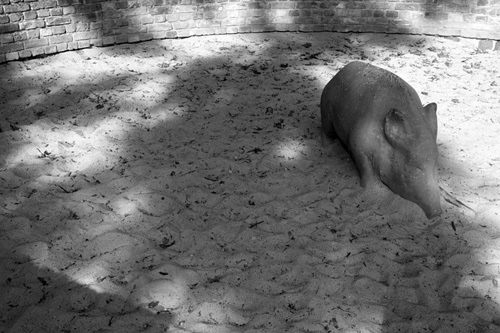
A wild boar stands in the middle of a perfectly round sand box. This animal is carved out of scavenged stones from the ruins of post war Berlin. It is part of the large playground near the Lutherbrücke, in the proximity of Haus der Kulturen der Welt.
There are five playgrounds in Tiergarten, all built in the ’50s by Willy Alverdes, then Tiergarten director. These places look serious. They not only possess the rationalized attitude of providing the right amount of “sun and hygiene” with their water pumps and simple sheds, specific of the time, in their frugality they show more unconventional characteristics: originally they had no fences, only slight earthworks and existing plants to set them apart from the rest, retaining walls double as benches. The most striking features are the elements re-used from a war-damaged Tiergarten, such as dead trees becoming climbing props, or toy horses cut out of drift wood. The most handsome of all remains the stone boar, probably mocking another much older sculpture nearby, a cast-iron wild boar stabbed to death by royalty in the middle of a hunting game.
A wild boar stands in the middle of a perfectly round sand box. This animal is carved out of scavenged stones from the ruins of post war Berlin. It is part of the large playground near the Lutherbrücke, in the proximity of Haus der Kulturen der Welt.
There are five playgrounds in Tiergarten, all built in the ’50s by Willy Alverdes, then Tiergarten director. These places look serious. They not only possess the rationalized attitude of providing the right amount of “sun and hygiene” with their water pumps and simple sheds, specific of the time, in their frugality they show more unconventional characteristics: originally they had no fences, only slight earthworks and existing plants to set them apart from the rest, retaining walls double as benches. The most striking features are the elements re-used from a war-damaged Tiergarten, such as dead trees becoming climbing props, or toy horses cut out of drift wood. The most handsome of all remains the stone boar, probably mocking another much older sculpture nearby, a cast-iron wild boar stabbed to death by royalty in the middle of a hunting game.