18) Cougars
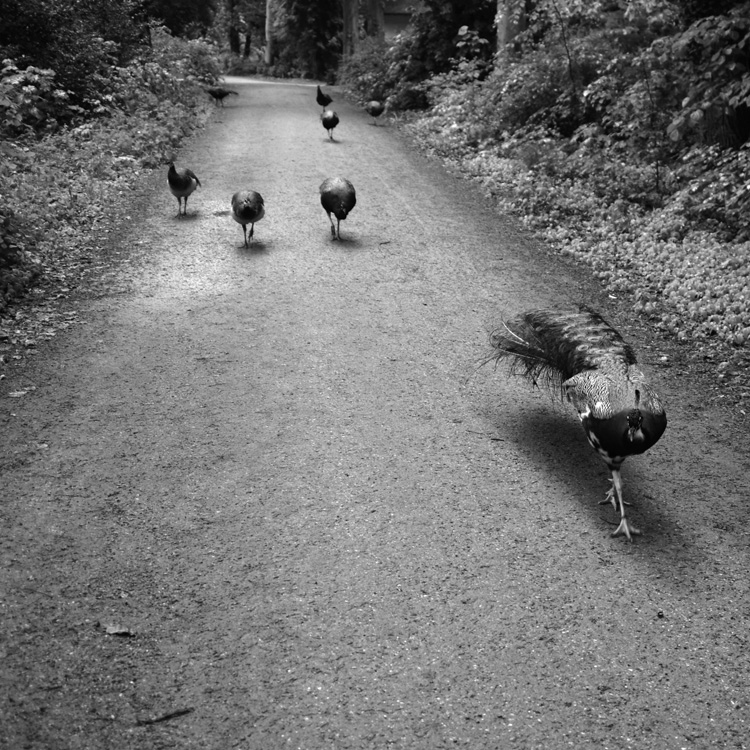
Pfaueninsel is very different from Tiergarten, still both places deeply relate: in their mutual relaxed slackness, their mysterious lines of sight, juicy tender leaves and the constant crumbling of tree barks, branches and artifacts. Pfaueninsel, the “Island of Peacocks”, is the way it is out of its isolation and the farsighted conviction of its guardian; Tiergarten results out of obscureness. Arthur Ovaska stated that the Pfaueninsel was key in the envisioning of Berlin Green Archipelago, a 1977 projection of a future Berlin like conglomerates of built islands emerging in an ocean of undefined open space and vegetation, where anything can grow, live and happen. Arthur, while strolling on the island for the first time in the late ’70s, was confronted with a large peacock in the middle of a trail; overwhelmed he imagined that the appearance of a cougar as the next step wouldn’t take him by surprise. That future, as described in Berlin Green Archipelago, had congealed in this moment.
Pfaueninsel is very different from Tiergarten, still both places deeply relate: in their mutual relaxed slackness, their mysterious lines of sight, juicy tender leaves and the constant crumbling of tree barks, branches and artifacts. Pfaueninsel, the “Island of Peacocks”, is the way it is out of its isolation and the farsighted conviction of its guardian; Tiergarten results out of obscureness. Arthur Ovaska stated that the Pfaueninsel was key in the envisioning of Berlin Green Archipelago, a 1977 projection of a future Berlin like conglomerates of built islands emerging in an ocean of undefined open space and vegetation, where anything can grow, live and happen. Arthur, while strolling on the island for the first time in the late ’70s, was confronted with a large peacock in the middle of a trail; overwhelmed he imagined that the appearance of a cougar as the next step wouldn’t take him by surprise. That future, as described in Berlin Green Archipelago, had congealed in this moment.