29) Potsdamer Platz
At the end of the film Donnie Darko, Donnie travels through a wormhole in order to save world. The world is a personal universe of family, home, school and the dealing of adults who lost hope and innocence, corrupting the young with each decision every day. Donnie rides up a hill with his bike, from the top he steps into a wormhole’s portal and finds himself 28 days back in time, and back into his bedroom, shortly before an airplane turbine falls into it.
Every day there is Potsdamer Platz. It used to be that above it and around it there was nothing, its cardboard buildings made out of scaffolding and billboards seemed to be a mere fantastic narrative. Now it is in the process of ever becoming more real. But glitches are still there, portals that exit sometimes into the wilderness of the Tiergarten, or in an underground Asian world below Sony Center, and eventually in everybody’s living room.
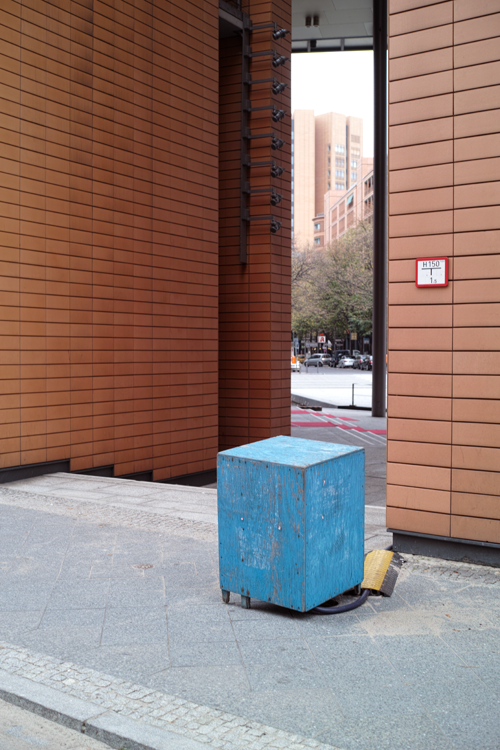
A solitary road runs between the back of the golden library of Kulturforum and the casino building. The road, plastered with old cobblestones, is a relic from some other story. And a tall narrow portal opens in the middle of it, breaking through the casino. One hesitates to enter it. The portal opens a brief view to a density of fast food places, red carpets, ice-skating rinks, Jeff Koons site specific art. From the other side this opening is utterly invisible.
At the end of the film Donnie Darko, Donnie travels through a wormhole in order to save world. The world is a personal universe of family, home, school and the dealing of adults who lost hope and innocence, corrupting the young with each decision every day. Donnie rides up a hill with his bike, from the top he steps into a wormhole’s portal and finds himself 28 days back in time, and back into his bedroom, shortly before an airplane turbine falls into it.
Every day there is Potsdamer Platz. It used to be that above it and around it there was nothing, its cardboard buildings made out of scaffolding and billboards seemed to be a mere fantastic narrative. Now it is in the process of ever becoming more real. But glitches are still there, portals that exit sometimes into the wilderness of the Tiergarten, or in an underground Asian world below Sony Center, and eventually in everybody’s living room.
A solitary road runs between the back of the golden library of Kulturforum and the casino building. The road, plastered with old cobblestones, is a relic from some other story. And a tall narrow portal opens in the middle of it, breaking through the casino. One hesitates to enter it. The portal opens a brief view to a density of fast food places, red carpets, ice-skating rinks, Jeff Koons site specific art. From the other side this opening is utterly invisible.