58) Goldfischteich
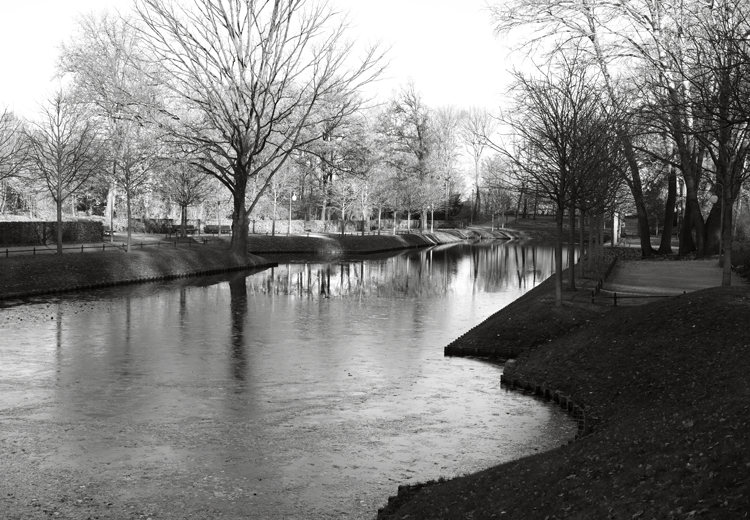
Goldfischteich (Goldfish Pond) is ancient. First appearing in 1757 as a sunken field of stark geometric shape becoming a small water reservoir called Venussbassin. It is then enlarged and deepened by P. J. Lenné to help the flow, after he plans a network of streams through the Tiergarten. P. J. Lenné drafts many variations where the Venussbassin disappears and reappears as a pond of loose contours or as an ornate square basin, with a statuary Venus overlooking the water, lovingly. Later the pond contains rare varieties of goldfish, a present from Russian royals, and the name changes into Goldfischteich. During the 19th century mania for heroic monuments, manly to the core, the Venus is taken away, substituted with the “Musikerdenkmal” (Musicians’ Monument), massive and golden, nicknamed by the general public with “The Stove”.
In the ’50s, during the replanting of Tiergarten the pond is reconstituted as a more relaxed thing: its war bombed edges become even softer and are generously planted. This new Goldfischteich is a thriving place, isolated, between the Entlastungsstraße on the west side and the Berlin Wall on the east. In its proximity a dry sloping area is planted with the peculiar vegetation from semiarid steppe territories. Many regular visitors, people as well as animals, find themselves separated from the mundane rest in a bizarre and compelling Eden of plants, water and sand, between the concrete of the fast trafficked road and the Wall. It is true that this place is loved by many.
After the fall of the Wall and later of the Entlastungsstraße, the city, in its ongoing struggling quest of its true historic authenticity, has the Goldfischteich stripped down of its plants and reshaped into a bare geometric figure, naming it again Venussbassin, but without a Venus. Two rudimentary wooden ramps provide an escape for wild animals after a fox is found drowned in the basin. The garden of semiarid steppe plants is also bound to disappear if it weren’t for a small group of people who, after occupying it at first in sign of protest, is now directly taking care of the garden out of their own pockets. This piece of steppe grows on the side of the transfixed Venussbassin like a strange fungus, a blob that is barely tolerated by the powers that be, in the clash of geometries.
Goldfischteich (Goldfish Pond) is ancient. First appearing in 1757 as a sunken field of stark geometric shape becoming a small water reservoir called Venussbassin. It is then enlarged and deepened by P. J. Lenné to help the flow, after he plans a network of streams through the Tiergarten. P. J. Lenné drafts many variations where the Venussbassin disappears and reappears as a pond of loose contours or as an ornate square basin, with a statuary Venus overlooking the water, lovingly. Later the pond contains rare varieties of goldfish, a present from Russian royals, and the name changes into Goldfischteich. During the 19th century mania for heroic monuments, manly to the core, the Venus is taken away, substituted with the “Musikerdenkmal” (Musicians’ Monument), massive and golden, nicknamed by the general public with “The Stove”.
In the ’50s, during the replanting of Tiergarten the pond is reconstituted as a more relaxed thing: its war bombed edges become even softer and are generously planted. This new Goldfischteich is a thriving place, isolated, between the Entlastungsstraße on the west side and the Berlin Wall on the east. In its proximity a dry sloping area is planted with the peculiar vegetation from semiarid steppe territories. Many regular visitors, people as well as animals, find themselves separated from the mundane rest in a bizarre and compelling Eden of plants, water and sand, between the concrete of the fast trafficked road and the Wall. It is true that this place is loved by many.
After the fall of the Wall and later of the Entlastungsstraße, the city, in its ongoing struggling quest of its true historic authenticity, has the Goldfischteich stripped down of its plants and reshaped into a bare geometric figure, naming it again Venussbassin, but without a Venus. Two rudimentary wooden ramps provide an escape for wild animals after a fox is found drowned in the basin. The garden of semiarid steppe plants is also bound to disappear if it weren’t for a small group of people who, after occupying it at first in sign of protest, is now directly taking care of the garden out of their own pockets. This piece of steppe grows on the side of the transfixed Venussbassin like a strange fungus, a blob that is barely tolerated by the powers that be, in the clash of geometries.