Art and Lethargy
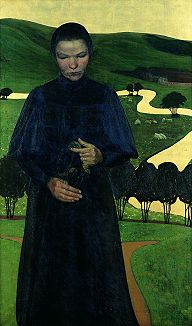
Ejnar Nielsen, Die Blinde. Gjern, 1896/1898
Why is art so hard to look at? Sometimes it feels like regarding a too-bright landscape at midday, the sun glinting off of every surface. Or being in the mall, Rihanna singing at a harmless volume, drifting from clothes racks, feeling sweaters. I know it’s uncouth to compare looking at paintings (high culture) to looking at clothes (consumer culture) but the eye grows similarly exhausted regarding objects that some third party (the museum / the boutique) is begging you to care about, imploring you to make your own, whether you literally buy the sweater, or subjectively buy what the artist is attempting.
Despite feeling like I needed to lie down for the next year after an hour at the Hamburger Kunsthalle (it didn’t help that Erwin and I had made a dutiful attempt to explore Hamburg’s nightlife just twelve hours earlier), I did find myself caring deeply about several of the paintings at the stiffly titled exhibition “Denmark’s Breakthrough to Modernism.”
One room of “Interiors” was particularly comforting and private. The solitary figures in the rooms seemed like such happily trapped animals: sheltered in thick brick walls, safe from nature’s peril, but nonetheless perched at windows, as helpless as moths, soaking what little light bled through the shades.
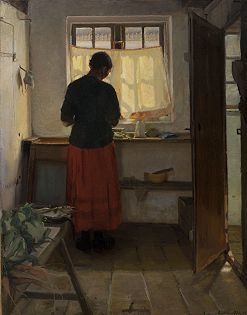
Anna Ancher, Die Magd in der Küche, 1883/86
And the Symbolist room was stunning for the uncompromising insistence of the artists’ visions, painting the parallel world behind their eyelids. My favorite was called “Spring” by Harald Slott-Møller. (It’s hopelessly girly to have your favorite painting be “Spring,” but there you go.)
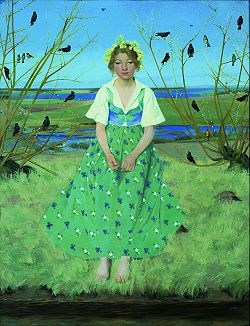
Harald Slott-Møller, Frühling, 1896
The audio guide reported that critics lambasted the painting for “trying too hard,” which seems like one of the cruelest detractions possible, along the lines of “I just didn’t love it enough.” Then the sonorous male audio guide voice quoted the Danish writer Johannes Jørgensen:
A landscape is a state of the soul. Regarded superficially, this states the self-evident. But when understood at a deeper level, this statement contains one of the fundamental truths of symbolism, because art means to discern things in an almost dark way, as if looking at them through a glass. All real art is and becomes symbolic.
It seems to me that the biggest challenge for the artist is not to paint something that will convince viewers of the painting’s truth, emotional or otherwise, but rather whether the artist believes the lie he tells. How to set up the glass between oneself and the subject, so that you see things in this “dark” way.
Erwin and I walked from the museum across the city to a lovely old movie theater, where we saw Woody Allen’s latest, terrible film. The characters were as interesting as an Ikea bookshelf. We walked home in the swift dark. The only conclusion I can draw from all of this is that the best art lulls its makers and its witnesses into quiet seconds of staring at something just beyond the frame.