Behold
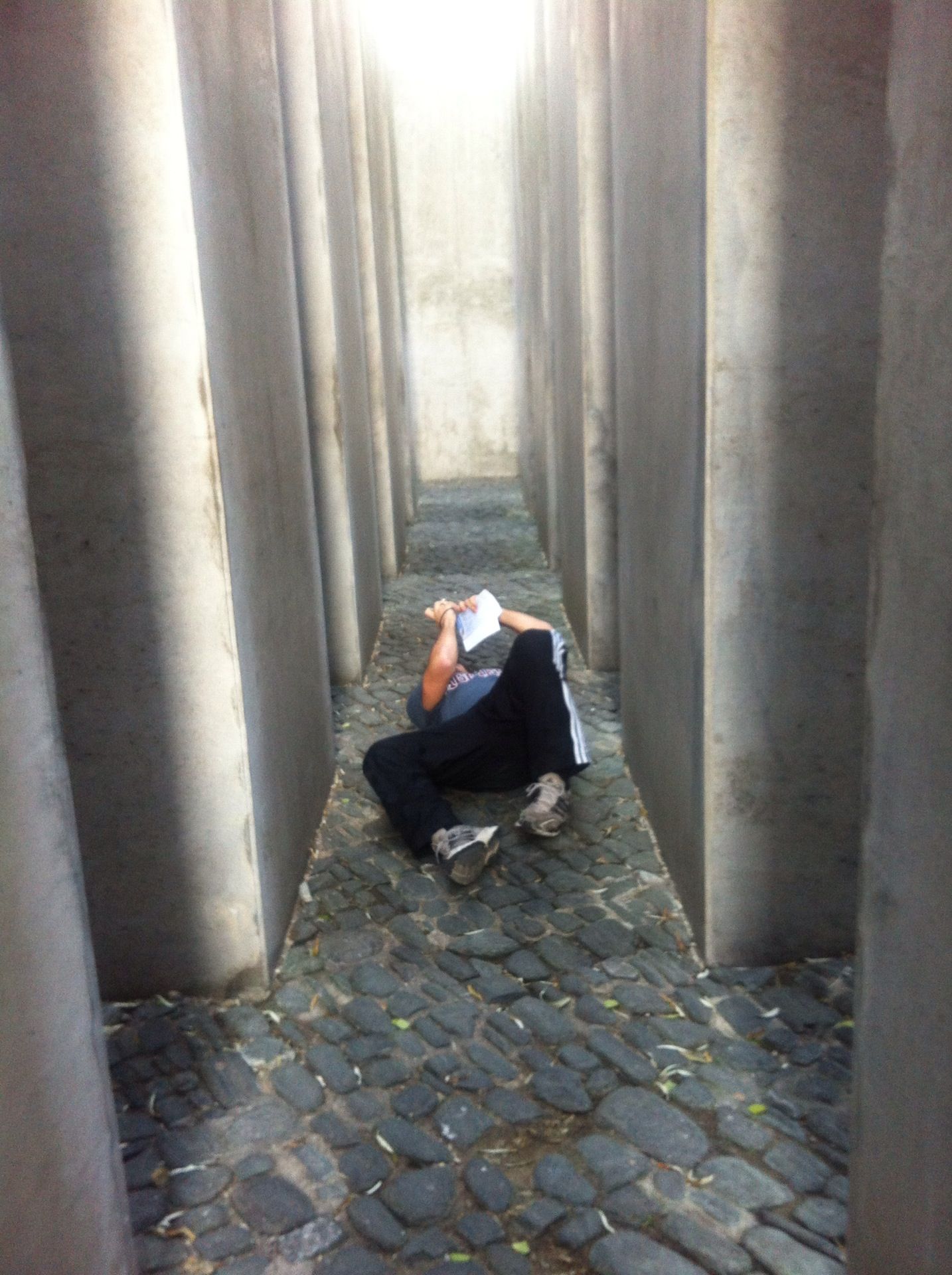
Behold! This is a picture I took of a student of mine taking an abstract aesthetic photo of the sky from the Garden of Exile at the Jewish Museum of Berlin. I took this because I wanted to record how my (American, Texan) students responded to a memorial within a museum that itself is a memorial.
Berliners, Germans, if you can remember that building before it had “contents,” you know that Libeskind’s statement-in-architecture felt like the physical manifestation of the dizzying end to a very uncomfortable and long-winded debate. A debate about how to commemorate the horrors and yet not preclude the possibility of a new embodied Jewish life in Berlin.
My students know nothing of that debate, but they sensed my emotions as I spoke about it. Their behavior was exemplary in the Garden of Exile. As if they were going out on a date for the first time with a girl they really wanted to impress. They, all Americans, tried to reach back to ancestral memories about their own families’ immigrations, some under duress. They wanted to find some personal reference. Mostly they struggled with the idea that anyone would long to “return,” whether to Germany, to Europe, or in the biblical narrative of return to the Holy Land. Who needs to worry about that so much anymore?
And that American optimism was on full display when they all found the bright side of the experience: the beautiful, iridescent Berlin sky visible through the pillars in the Garden of Exile. One student with a camera, live-blogging our study trip from Texas to Berlin, got on the ground to record that important and sharable observation (pictured).
Another student asked, “Is this Garden a referential place to the Denkmal für die ermordeten Juden Europas,” like some sort of metastasis to a grief that runneth over on the other side of town? Somehow it doesn’t matter anymore the chronology (first Jewish Museum, then Denkmal, with so many debates in between those constructions). Our experience of monuments and museums as monuments is flat, asynchronic, cyclical and referential. Why quibble with history or origin or intentions now so insignificant? So after a long sigh, and a look up into the sky, I said, “sure it is.”