Cut Matthew McConaughey some slack
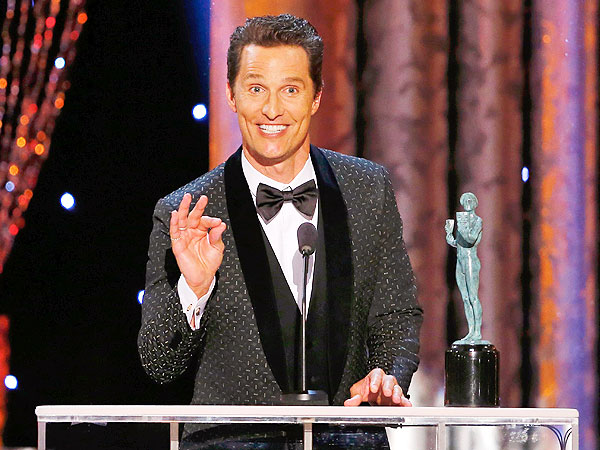
Pundits and peers are giving Matthew McConaughey a hard time for his rambling, incoherent acceptance speech at Saturday’s Screen Actors Guild awards. The web community is no less vitriolic. McConaughey’s agitated 2.5 minute monologue about thespian virtues and space travel to Neptune instantly went viral and will be used as proof of actors’ intellectual limitations for years to come. Honestly, I didn’t think the speech was that terrible. Although a bit forced, it was overall amusing, refreshing and, most of all, genuine. After seeing the man’s exquisite performances in “The Wolf of Wall Street” and “Dallas Buyers Club”, I’m willing to forgive him a slip of the tongue or two.
Nevertheless, McConaughey’s appearance at the ceremony was underwhelming compared to his exploits on screen. The fact that he’s being publicly crucified for it is not surprising but still peculiar. It has to do with the unique profession that is acting. And it has to do with a huge misconception about the true nature of that profession.
Acting is the only job where you have to be better at being someone else than your own self. That’s pretty remarkable. Most people can barely manage the one life they lead without a significant amount of drama. Actors are no different in that respect, of course: if they’re dedicated and put everything into their roles, they may very well end up being consumed by them. There are enough examples of actors excelling on the screen but failing in life or barely turning the corner: Marlon Brando, Robert Downey Jr. in his early career, Winona Ryder, Heath Ledger, the German entertainer Harald Juhnke, the list is endless. That in itself is just a superficial observation. What’s causing confusion is the fact that the greatness of a role is enhanced by the medium: on screen, the essence of a character is delivered in such high concentrations that it truly becomes larger than life.
This transformation is responsible for the misconception about acting, which is all about projection. Moviegoers automatically assume that the character on screen has something to do with its impersonator. Method acting contributed to that notion in a big way because it assumes that you can only play a role convincingly if you get into your character’s skin, if you live and breathe like it, bulk up or drop pounds to look like it and take on its accent and mannerisms. This art, practiced by the likes of Daniel Day-Lewis (always), Robert de Niro (sometimes) or Christian Bale (once), codifies the identity of the role and the performer. Off screen, good actors are in a constant fight against their roles in order to break that perception. For the public, there’s no other way than being disappointed if the spell is broken. It is shocking how poorly some actors perform when the lights are out. And it really makes you wonder not only about the skill that’s needed for acting but the nature of personality as such. How is it possible to be so good at impersonating someone despite having nothing in common with him?
I’m not an actor, so I don’t have a definitive answer. All I can do is take an educated guess. My guess is this: what a certain character does and knows is completely irrelevant to the actor. All he needs to do is to play his part in a compelling way. If by empathy, method acting, personal experience, imagination or a combination of the four. That it works is all down to the fact that he carries the seeds of multiple personalities within him. So it may well be that Matthew McConaughey is better at not being Matthew McConaughey. Him being himself just happens to be the role that people seem to like the least. Too bad if it’s the one he spends the most time playing.
http://www.youtube.com/watch?v=NMzugHyGpnc