deborah’s book came out this week
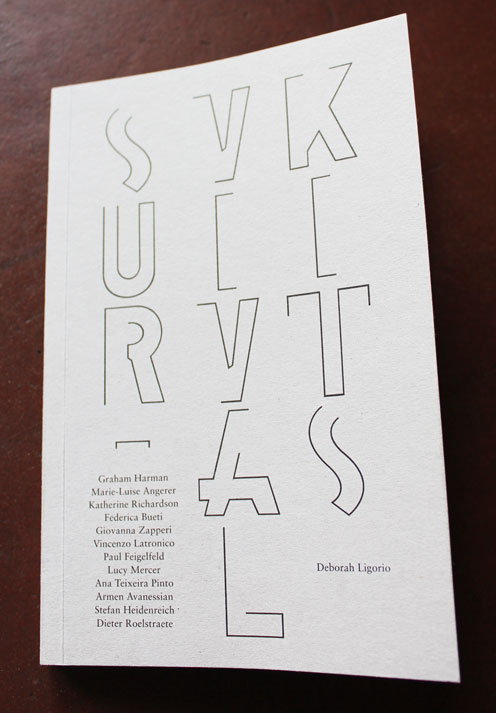
Criticism – Crisis – Acceleration
Armen Avanessian
Monetarization indexes a becoming-abstract of matter, parallel to the plasticization of productive force, with prices encoding distributed SF narratives. Tomorrow is already on sale, with post-modernity a soft-commodity, subverting the modernist subordination into continuous crisis (prolonged critically). —Nick Land
No one wants the crisis and everyone wants it to simply go away. But what or who is the crisis, and how does it operate? What keeps it alive, or rather what is keeping it alive? Since quite some time now, at least since the work of Gilles Deleuze and Felix Guattari, we can no longer be ambiguous or naïve about this issue: perpetual crises are nothing more than the immanent and constant means of capitalistic production. And anyone who does not willingly ignore today’s crisis-fiasco must recognize financial and political opportunism as the strategic motivation behind it. It has become an excuse for expanding neoliberal measures in the financial sector, in the health sector, and in the security sector. The perpetuation of a crisis-ridden status quo is—as has already been argued, but has certainly been overlooked by the critical left—a means of legitimizing ongoing “reforms.” In fact, these reforms have been enacted over the past decade mostly in order to expand supernational competition at the expense of former social achievements. The announcement of a crisis, therefore, reveals a false consciousness that views the status quo as something given, perceives an existing regime as being in danger, and seeks to expand every opportunity of broadening its power of influence through controls.
Due to the obviously ideological character of the “crisis,” I am less interested in defining what the crisis is—the “what” of the crisis—but more interested in questioning the “how.” Even beyond that, the question is not how and where the crisis’s phantasma makes its mischief, but how that disruption is even possible. Why feign being against the crisis, and against the discourse of crisis, when there is no solution? And what does the typical (left) reaction actually look like, when it at once calls for a solution and the total eradication of the disastrous effects resulting from the ideology of crisis? Critique is what we can call the typical response to every acute crisis unleashed under neo-liberalism. Crisis and critique, then, represent two sides of a well-rehearsed pair, reciprocally implicated and dependent upon one another. The political, then, as well as the artistic and overarching intellectual paradigm of critique is not only impotent, but maybe even counter-productive. (…)