Family resemblances
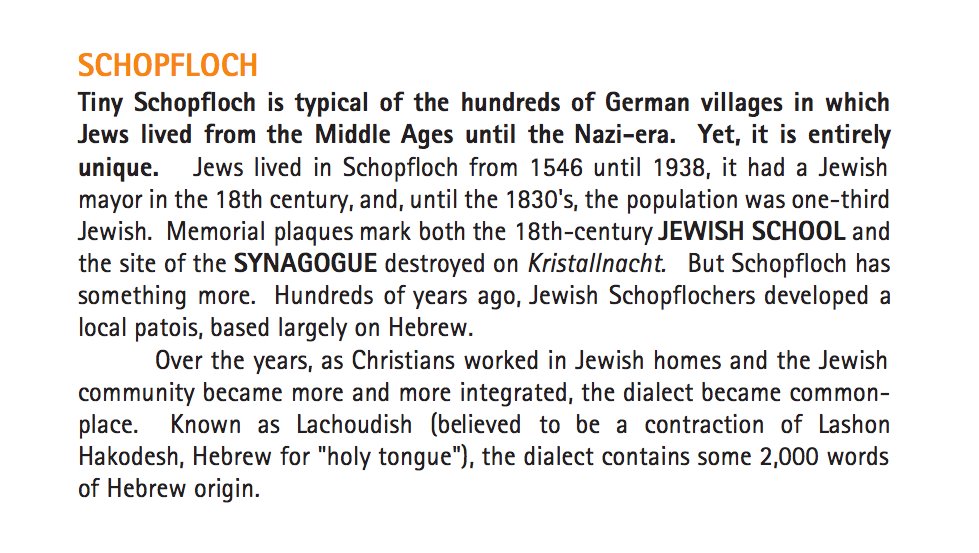
It all began with this, a little blurb I found about a little Bavarian town on the Jewish Museum of Berlin’s website. The town is called Schopfloch, which has the unfortunate, nonsensical approximate meaning of “hair hole.”
There have been so many metaphors and bon mots to describe the relationship/non-relationship of Germans and Jews that I have forgotten them all. There’s the symbiosis, the friendship, the dialogue and its skeptical counterpart, the “myth of the German Jewish dialogue,” a Zweistromland, the “tragedy of it all,” and so on.
But nothing prepared me for this description about Hair Hole: that non-Jews learned Jewish Hebrew terms while working for them and then co-opting that language as their own. My fantasies run amok: were these Schopflochers some very astute Shabbos goys who lived in the houses of wealthy Jews and who somehow psychologically identified with their employers, after which they began to pepper their Stammtisch conversations with Hebrew?
But a bit more digging revealed that Schopflochers, whether Jewish or non, were involved in the cattle trade together and at any given time from the late Middle Ages to the Industrial Revolution, the large number of Jews in the town working in this industry with non-Jews made them a significant presence in the community. But this language is not about stretching your German to sound a bit more Yiddishy because it sounds better. This is a hybridized patois, caused by the creolization of cultures, if I may be allowed to use that term in this context.
But this is what is so amusing: they call this dialect, Lachoudesh, from loshen kodesh, Hebrew for the holy tongue. For at least one thousand years of the real holy tongue’s history in Europe, Hebrew was studied and learned by translating the elevated language of the holy writ into everyday taytsh, and then speaking about it in that same old taytsh: the language that the Jews of Europe spoke and understood. You and I both know taytsh comes from the same origin as Deutsch. And indeed, taytsh is what we today call Yiddish, more or less.
This Hebraized German language became, according to locals, a secret language of the Schopflocher tradesmen: Germans and Jews conspiring against the buyers of their cattle? Isn’t it just deliciously ironic, this idea that the base, provisional, non-national, non-religious language they came up with together in the diaspora has the name, the “Holy Tongue”? Someone has a great sense of humor.
Follow the link yourself to hear it spoken! http://br.de/s/VzGc5j