Google is … [AUTOCOMPLETE]
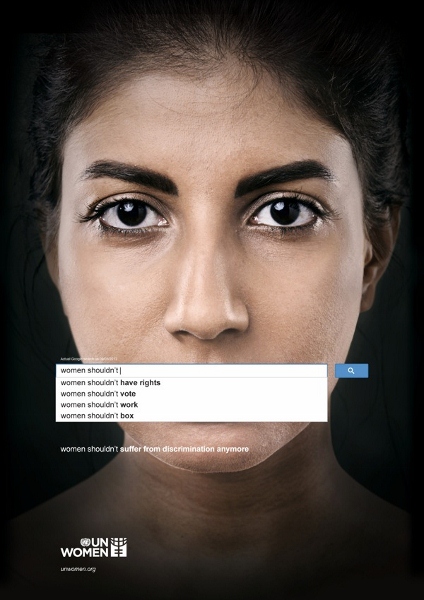
UN Women has recently launched a campaign against sexism. The pictures show close-up portraits of women’s faces, on which, instead of the mouth, appears a Google search box. In it, the beginning of a sentence such as “Women shouldn’t” and beneath it Google’s suggestions on how you should complete that sentence: “have rights”, “vote” or “work”.
The ad series, according to the UN Women website, is based on original Google searches that were conducted in March 2013, and the according autocomplete suggestions.
The Internet, as a mirror of our collective soul? That’s how many have interpreted the search engine’s function that seems to reveal wide-spread misogynistic thoughts. The Guardian headlines: “Google’s autocomplete spells out our darkest thoughts”. Earlier this year, related to legal cases of for example Angela Merkel, who was not amused about Google suggesting to associate her name to FKK (nudism), Zeit Online wrote: “Google zeigt nur, was wir denken” (Google only shows, what we think).
More than a mirror of collective thoughts, the Internet seems to have become the new public sphere, in which meaning is negotiated, contested and fought over. While in pre-Google-times, debates were actually held in physical social spaces such as bars or town squares, and latent social sentiments would appear, if at all, in abstract discourses – here it is now: The visible revelation of all our prejudices, all of our society’s most disconcerting conflicts. Black and white, incontestable algorithms.
Just as Google’s autocomplete function reveals beliefs and attitudes, so called Wikipedia ‘edit wars’ unravel conflicting writing of history. An edit-war is a case where changes on articles are reverted by one or several other users as soon as they happen, leading to an endless loop of revision. A study by the Oxford Internet Institute analysed the most controversial Wikipedia-articles, i.e.: those on which the most changes have been undertaken. The results are telling, yet not surprising: The top three topics were Global warming, homosexuality and abortion.
Have we eventually found the proof, the objective evidence, that knowledge is not static, singular and either right or wrong? That it has much rather always been socially negotiated and agreed upon?
Now that these conflicts over claims of truth become visible, we have much more ground to resist creeping in ideologies, such as sexism. So, if the majority of Google-users really do think that women shouldn’t vote, at least we know, what we should be fighting against.