Gravity
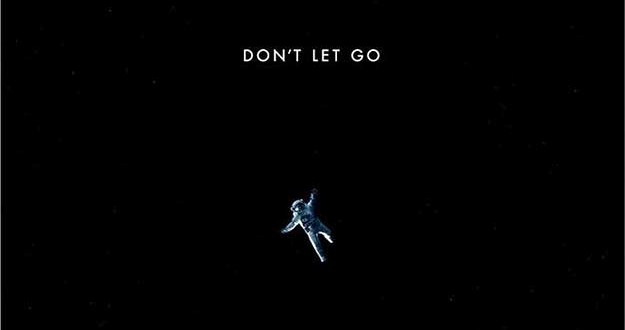
People, everyone: go see Gravity. In 3D. It is the future of film. It is every film ever. It’s the story of everything.
The opening shot instigates what must be a substantial cinematic or Euclidian or Cartesian revolution – the hemisphere of the blue planet looms onto the screen and just hovers there in deep black space, no more than that. The scene is somehow brilliantly too long, uncomfortable, people started giggling nervously in the audience. There is no audible sound, only slowly from the distance quiet radio communication between Houston and the three astronauts working on the space shuttle who calmly gyrate into view of the cinemascope eye.
When George Clooney asks Sandra Bullock what she likes about space, she answers: the silence. And the silence is fucking loud in this film, space debris catastrophically impacting space stations without a sound, unlike any other blockbuster. But in this scene, her confessing that she could get used to the silence becomes the cue for the film’s score, a swelling of chords, Sphärenharmonie, music of the spheres, musica universalis. By this time, ten minutes into the movie, after watching Clooney spin around the space shuttle and the camera spin with him, my legs in row H of Berlin’s Cinemaxx were already as heavy as lead, impossible to lift, my body being an incredibly inept and burdensome object in this space age of cinema.
I don’t want to take anything away from this film by spoiling it (although it can’t conceivably be spoilt), but here a few details of the trillion things that are great about it. The Russian Soyuz’ weird silky lavender fabric shell. The strange flowing green grassy insulation of the Chinese Shenzhou spacecraft. At one point, Bullock (Dr. Ryan Stone) ends up in a desperate, random radio transmission with a Greenlandic Inuit, with whom she can only communicate in howls and barks imitating him and his dog, howling at her neighbour the moon, howling like Laika on Sputnik 2. Stone’s fate comes down to (mis-)reading incomprehensible Chinese signs in the Shenzhou.
Gravity owes much to Kubrick, much to Tarkovsky, nods to Ridley Scott and Ripley’s iconic outfit, and apart from Werner Herzog’s Cave of Forgotten Dreams might be the only movie (so far) where the element of 3D is integral, where space is both medium and matter. There is a structural similarity, too, to Herzog’s film – the coda of Gravity shows a frog swimming through a lake, evolution incarnate, sea creature morphing into land animal, reminiscent of Herzog’s mutant radioactive albino crocodiles which he phantasmatically hallucinates as being simultaneously our ancestors and our successors.
Gravity is about the most terrifying thing imaginable – life in space. It is about birth and trauma, detachment, immersion, hypoxia, impact, and learning how to dance in space, how to adapt to and make beautiful what is uninhabitable and hostile. The end scene haunts me.
There is one detail which was particularly touching. Amidst the beautiful and detailed high-tech equipment of the space suits, one single analogue element turns out to be elemental: A small, tacky mirror on an elastic band around the astronauts’ wrists allows them to see things outside of their range of vision. Clooney watches Sandra Bullock with it while she talks about home. It itself is mirrored in a single tear that floats from her face in a later scene, towards the viewer, into the audience. This tear also functions as a mirror, in the same way that the whole of Van Eyck’s Arnolfini portrait is encrypted into the central convex mirror on the far wall: it engulfs, upside down and distorted (non-Euclidian, weightlessly), both worlds: extra-terrestrial and terrestrial, extra-diegetic and diegetic, external and internal, fiction and reality, actor and audience.