Guest appearance #4: David Gates
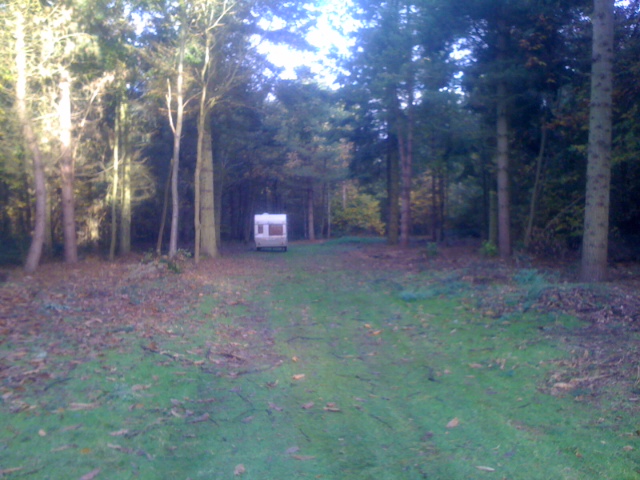
David Gates on his project to convert a caravan into a pinhole camera and place it in the woods of Essex:
“Why my caravan has become subject to threats of abuse, vandalism, arson, I don’t know, they’re not actual threats, they’re the projected threats of people witness to me using a caravan as a camera in some private Essex woodland, the builders who are installing a new fence around a pasture full of pedigree welsh black mountain sheep tell me they saw a fire engine driving into the woods, I mean they are just playing with me, I know they are joking, I don’t react, they even know I know they don’t mean it, it’s small talk, we’re just bleeting. The fence they are building is to stop the sheep escaping, one specific sheep has learnt to jump the fence, they’re afraid that she’ll teach the others, she has excellent peripheral vision and can see behind herself without turning her head, she waits, watching, until your back is turned, and then over, into the planned and established and forbidden gardens, where the grass is greener, chemically. She’ll be rewarded for this bravery.
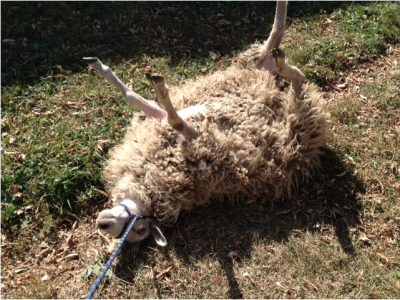
In the summer I found a sheep laid flat out on its back, legs akimbo, motionless and obviously dead. It must have been there a while as it had ground all the grass arced around its head and it had left large, dark, faceted masses, I mean it had shit everywhere, it was cast or riggwelted or cowped and with the housekeeper we rolled it on its side, it stood up, gathered itself together and resumed.
At the end of that field a fresh track leads into a privately owned and managed woodland, and in the woods my caravan is hidden, the mere sight of it may encourage thoughts of destruction to bored teenagers, so it is tucked away in a damp corner, these woods are still. There is an abundance of stinkhorns and those unfamiliar with the stinkhorn mushroom will know nothing of the stench of death it pervades, but taking photographs whilst smelling death seems to lean towards many conceptualisations about photography, none of which I’ve read too closely. But that is what I’m there doing, I’ve turned the caravan into a pinhole camera, 8 hour exposures, dawn till dusk, the longest exposure on the shortest day, the image is flipped upside down, it smells dead, it looks dead, or recently deceased and it waits to be mobilised.
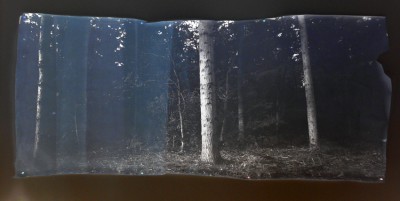
(David Gates, Little Bentley Hall Woods, 2013, 200 x 80cm)
Today I’m told that if you keep a cockerel in a small cardboard box for four days it will stop cockadoodling, and in this specific instance the cockerel could be heard during the Sunday service in the local church. Silence.”
2) In response to questions asked by Alison Yip, Claudia Barth, and Agnes Scherer
I don’t find the question and answer thing that comfortable, my response is to be creative, to try to make something new, to be vague, and move towards meanings in my work as they arise, as they reveal themselves briefly and slip out of view again.
* Do you believe in an objective timelessness that your images merely uncover, or do you think timelessness is a utopia (you are describing)?
Both, I mean, I flicker between the two, I think a continuous line is impossible to chart and I prefer to explore fragments, overlapping times. The more imprecise and vague that a reproduction is the more it reveals, I’m drawn to photos as things, I mean, an old photo is an image of the past but it is an object in the present if you hold attention to its surface, its process, its thingness. It is not a memory, but it is subjected to some of the difficulties of memory. Pinhole photography maybe lets me be explicit about things which are implicit in contemporary photographic techniques, in that they have a ‘look’, in that they provide a seemless surface, and I enjoy disrupting this surface, widening the gaps in the technologies of syntactical fits, to hold open temporarily the possibility of possibilities.
* A quote by Oscar Wilde says that in the landscape paintings of the English Pre-Raphaelites, it is always September. The summer is still visible but it is the moment of the first cool breeze and everything is charged with farewell. To me some of your dark landscape pictures are charged with a very similar, tragical mood, as if they were grieving over the irretrievability of what they transport.
Yes, that they can’t help being now and then.
* If Romanticism means allowing yourself to give into a longing for things you can find in images, but never in life, or things you consider irretrievably lost to the past, doesn’t this mean resorting yourself to an almost psychotic state of mind? To what extent do you think Romanticism has a destructive component to it?
It is trapped forever in inexhaustible images.
* Your practice of collecting and collaging and mailing pictures has a very intimate and tactile aspect to it. It may also deal with other people’s personal histories and lives in terms of some of the found imagery. How important is it to work in a domestic environment or for your work to exist in one?
I’ve never had a studio, only a spare room, I don’t know where anything is but I know it’s all there, mailing stuff allows me to insert myself into to other people’s lives, it disappears and reappears, it’s a conversation, broken, disjointed, unexpected. It only makes sense if both parties are speaking the same language.
David Gates, *1979 UK, lives and works in Essex and might be associated with The Rural College of Art.