Illegible script
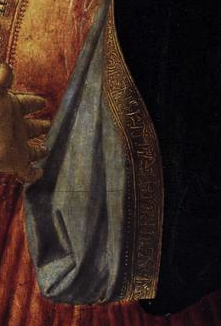
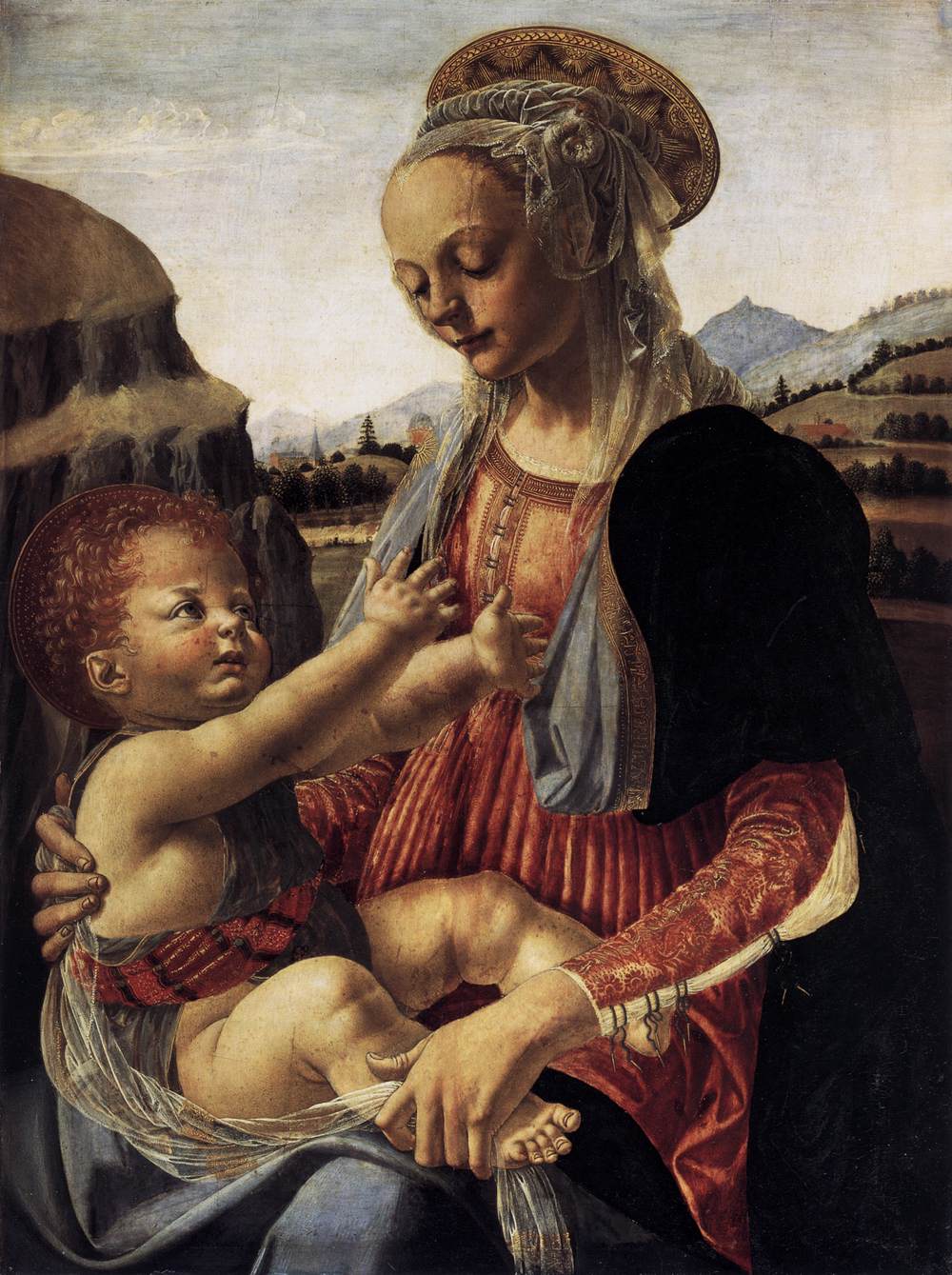
On the hem of the cloak of a Verrocchio Madonna with child (ca. 1470) you can discern a band of gold embroidery that resembles script, but which makes no sense. It is painted in perfect detail to bring to mind Arabic writing, however it is just an array of jumbled ornament. Andrea del Verrocchio would have seen and known Arabic writing from inscriptions on artifacts brought back to Italy from the Holy Land and could have simply copied a stance in order to uphold the pretence of authenticity. Instead, he chose to emulate Arabic signs without coherence, thereby rendering them meaningless, apparently signifying only themselves as script.
My art historian colleagues and I were following Alex Nagel through the Gemäldegalerie in Berlin in search of the many examples of illegible script in Early Modern paintings. In the case of the Verrocchio we huddled around the painting in the corner of the large hall of the museum, too many people to really be able to see the detail Alex was pointing out to us. Luckily, he had brought an iPad with a digital image of the detail in question, which, even though we stood crowded around the original, we turned to. Ironically in this case we were indeed not looking at a picture, but at text, at code, as Kittler would have said, a product of an algorithm only arbitrarily melding into a coherent image.
The illegible script in the painting is applied to the inside hem of Mary’s cloak which folds outwards in front of her chest and forms the border between the deep black textile over her shoulder and the crisp blue silky bunch of the lining. The chubby baby Jesus is stretching his arms up towards his mum, albeit strangely past and in front of her, his left hand opening and gesturing precisely toward this shiny pseudo-text. This kind of Entfaltung, unfolding, opening, complexity and intricacy of the reversed textile reminds me of the etymology of everything complicated, complex – plectere, to weave, braid, intertwine, fold.
The writing contains elements which resemble certain characters, but cannot be assembled to any kind of significance. Instead, their message is precisely that they are not legible. They convey the difference between meaning and significance. They tell the viewer that however hard he looks and reads, he will never quite understand what he is seeing – just as the scene in front of him, a mother and child bearing the message of sanctity and salvation, can be recognised, but not entirely understood. Referring to a Platonic concept of ideal and abstract ideas and their transit through different stages of medial manifestations to reach a point where they can be communicated to and understood by this compromised and earthly human mind, this script makes the promise of meaning that is waiting to be decoded, but that invariably eludes the beholder, that is just beyond what he or she can possibly understand. This, in the end, is no different to the iconic content of the painting, or to any painting, for that matter. We see whatever it is that we are given to see, but there is always a remnant, a residual element, of elusiveness within an image that originates from the ontological condition of a picture: of showing and not showing, offering and detracting meaning, of being at the same time mimetic diegeses and profound materiality.
Alex Nagel – whose research I am highjacking here – referred to the biblical incarnation of the logos, of the Word, in the form of the son of god, and to the etymological origin of the word cosmos: ornament, decoration. The word being the world’s genesis, incarnation, and the ornament being the cosmos, are sewn together on this delicate shiny hem.
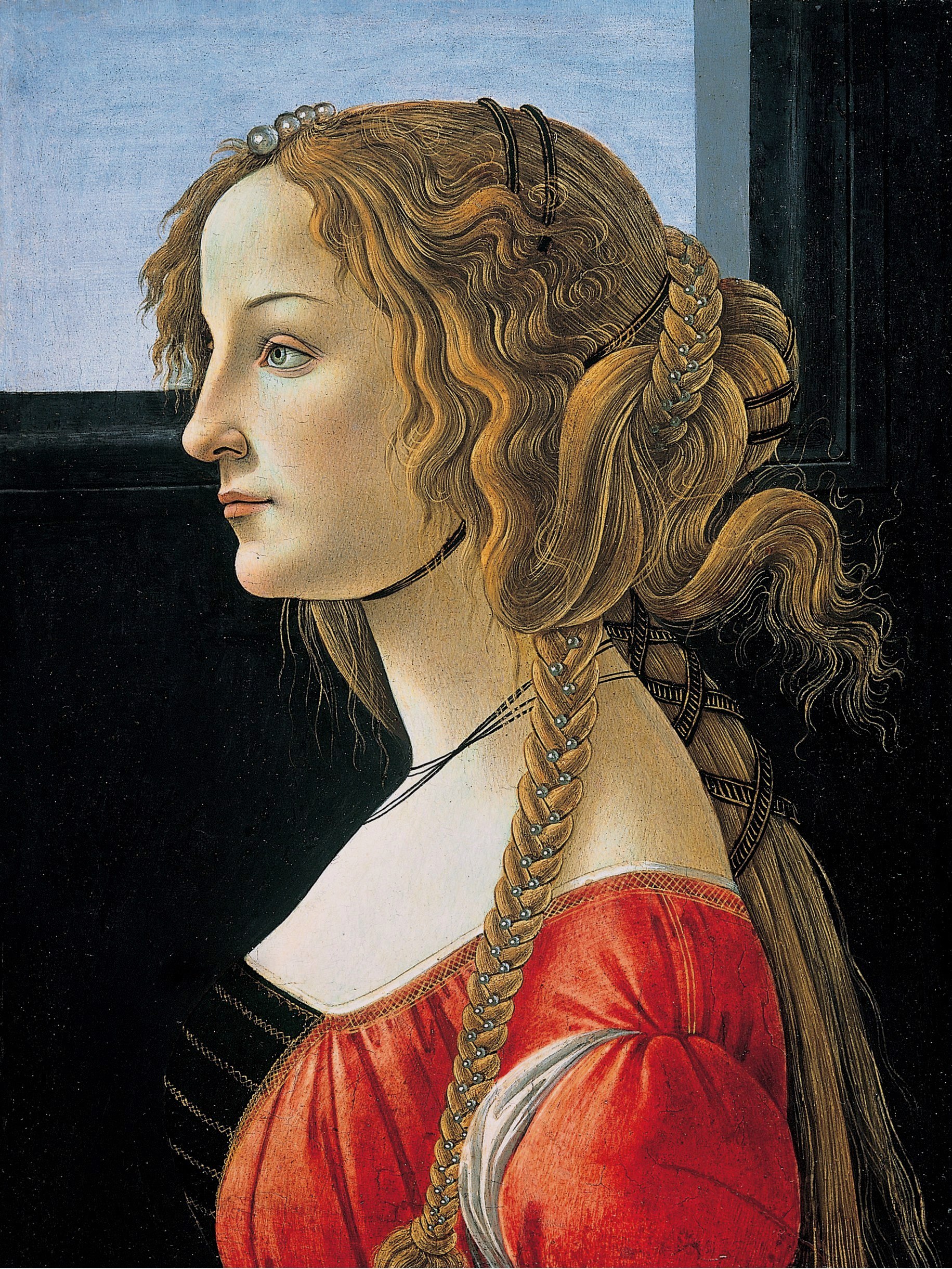
Interestingly, Botticelli, belonging to the generation following those masters who popularised illegible script in paintings, never once painted pseudo-script. Instead, you find the most labyrinthine braiding, weaving of hair, adorned with pearls and glass beads (reflecting the world), held by incomprehensibly knotted bands, entwined in itself and outwitting the viewer who tries to follow these intricate trails.
This might be over-interpreting the matter, but to me it seems that this is not a renunciation of the tradition of the illegible script but much more its logical continuation onto a more abstract, conceptual level of complexity, intricacy, implication, explication – in short anything to do with the origin of the fold.