Lovelace
No. Not Deep Throat.
We missed it. October 15th was the annual Ada Lovelace Day, honouring women in science, technology, engineering, and maths. Each year, it is hosted by a different institution – Imperial College London this year – and accompanied by a string of events.
For those of you who don’t know who August Ada King, Countess of Lovelace is, shame on you. She is most commonly credited to be the very first programmer – not the very first female programmer – in the history of computing. She was the daughter of Lord Byron and worked with Charles Babbage, one of the fathers of the computer.
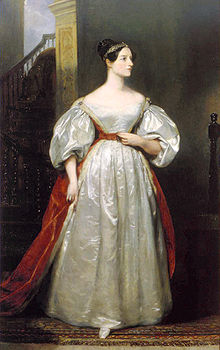
During a nine-month period in 1842–43, Ada translated Italian mathematician Luigi Menabrea’s memoir on Babbage’s newest proposed machine, the Analytical Engine. It was Babbage’s friend Charles Wheatstone, one of the most influential scientists of the Victorian period, who commissioned the translation. With the article, she appended a set of notes. Explaining the Analytical Engine’s function was a difficult task, as even other scientists did not really grasp the concept and the British establishment was uninterested in it. Ada’s notes even had to explain how the Engine differed from the original Difference Engine. The notes are longer than the memoir itself and include (in Section G), in complete detail, a method for calculating a sequence of Bernoulli numbers with the Engine, which would have run correctly had the Analytical Engine been built (only his Difference Engine has been built, completed in London in 2002). Based on this work, Ada is now widely credited with being the first computer programmer and her method is recognised as the world’s first computer program. Her work was well received at the time: Michael Faraday described himself as a fan of her writing.
You can find Menabrea’s text with Lovelace’s notes here.
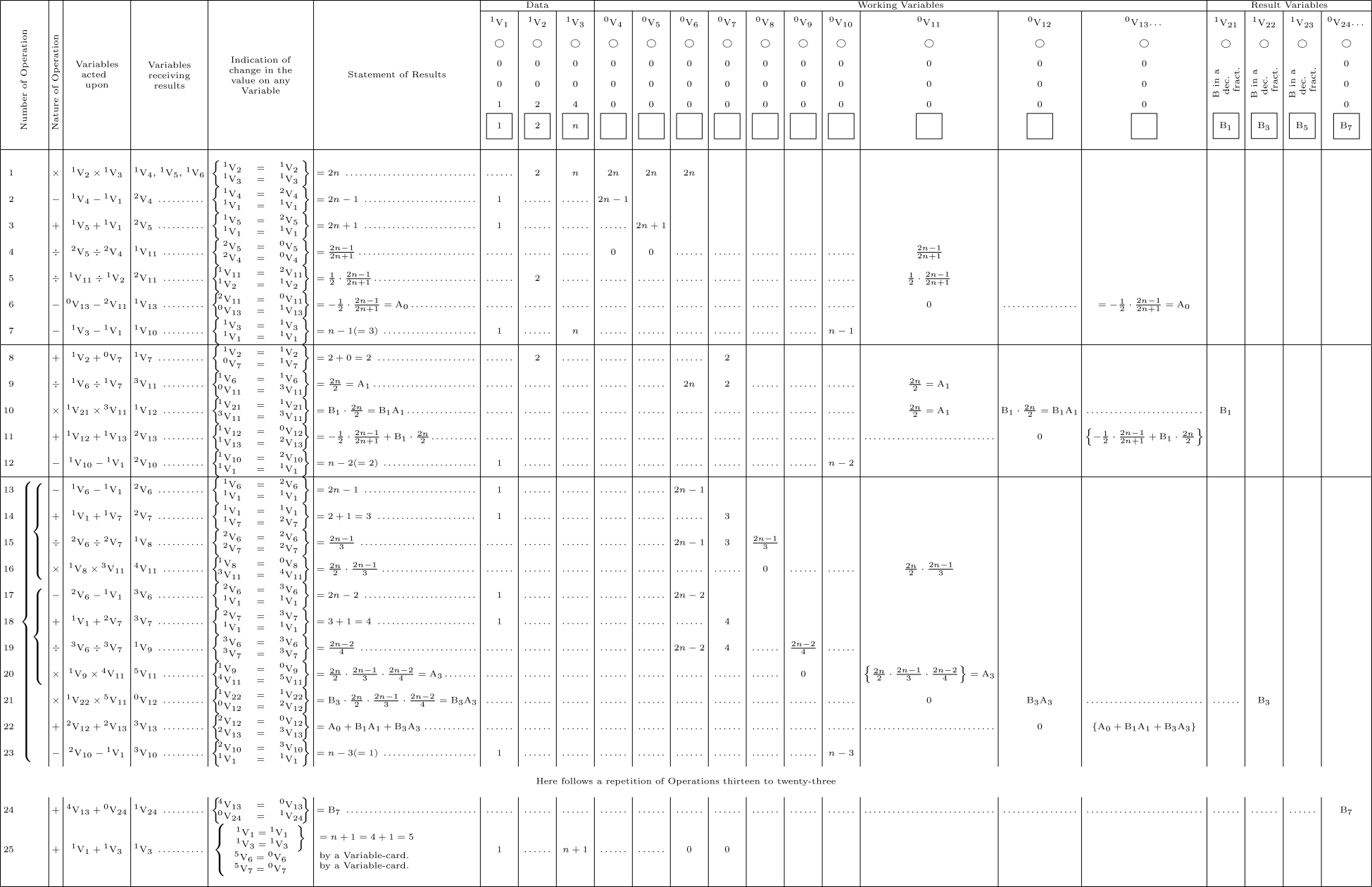
What Lovelace realized was that Babbage’s machine could in principle be used to solve problems of any complexity:
“[The Analytical Engine] might act upon other things besides number, were objects found whose mutual fundamental relations could be expressed by those of the abstract science of operations, and which should be also susceptible of adaptations to the action of the operating notation and mechanism of the engine… Supposing, for instance, that the fundamental relations of pitched sounds in the science of harmony and of musical composition were susceptible of such expression and adaptations, the engine might compose elaborate and scientific pieces of music of any degree of complexity or extent.”
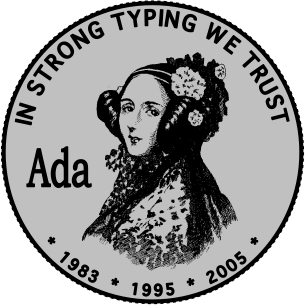
A 1970s programming language was named after her. ADA is a structured, statically typed, imperative, wide-spectrum, and object-oriented high-level programming language, extended from Pascal and other languages. It has built-in language support for explicit concurrency, offering tasks, synchronous message passing, protected objects, and non-determinism. Ada is an international standard; the current version (known as Ada 2012) is defined by ISO/IEC 8652:2012.
Then, there is an unbearable 1997 movie called Conceiving Ada, starring Tilda Swinton as a virtual reality Ada Lovelace.
Here is another good article about her: Ada Lovelace, an Indirect and Reciprocal Influence.