m(O)ther tongue
Jacques Lacan did not trust language. The French psychoanalyst’s suspicion of words was serious: In his late theories, he rejected them altogether as form of expression. “Where words fail, something else is appealed to” – he used mathemes instead:
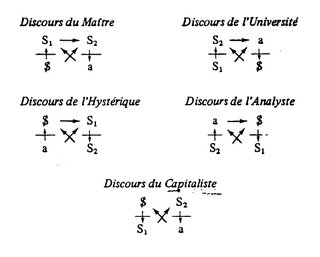
Why was language so dubious and equivocal to Lacan? What made him understand it as “a gift as dangerous to humanity as the horse was to the Trojans”, as Zizek describes?
Some of Lacan’s assumptions:
- Every word, every thought is part of a system deeply alien to human subjects: The symbolic, where the big Other reigns.
- Much before we learn a language, we are born into a pre-existing linguistic universe. A world of traditions, rules, norms and expectations is carried in the language our families speak, the names we are given.
- When we acquire language, this alienation is reinforced. To communicate our needs, we need to resort onto exterior signs. Our mother tongue, as Fink describes it, is necessarily “some Other’s tongue first”.
- After learning to speak, we are unable to think outside of these symbols. We are trapped in language. Even our most intimate thoughts cannot take any other form than a linguistic one. Every dialogue, spoken out loud or kept to ourselves, is expressed in the field of the Other.
- “I am not speaking, I am being spoken by language” means: Language is an exterior, impersonal mechanism, constantly distorting the intended meaning of what we are trying to say.
No way out of the trap? Au contraire! As much as language is operating on us, a superior universe to which we are subdued, it is precisely and only through language that we can act back upon it.
A possible escape: The “language-destroying twisting of language” that poetry can be. Dada poets have proven it. The creation of a new (“non sense”) language was the moment of literary creation, in which – through the celebration of “the infinite plenitude of nonsensical” – existing rules of what art has to be, were challenged and the social order transformed.