Nasty words
About a year ago, my mom sent into exile a selection of books to our new house in Tangier. She said it was a random selection, but most of them belonged to me of course, probably because of this tendency I have to drop my books in my parents house and leave. What my mom did was that she basically cut/paste a whole book shelve from Rabat to Tangier.
Most of the books do belong to me, but this summer when I was in Tangier, I picked one that is definitely not mine. I could not pass by its title without stopping : “L’amour dans les pays musulmans”, Love in muslim countries.
Fine, I took it, and brought it with me to Paris.
So what is this book about ? What are these two magic words doing together on this line. LOVE. MUSLIM (countries). Nasty nasty combination here.
This book was written by Fatema Mernissi, a Moroccan female scholar, writer and sociologist who happened to be one of the first Moroccan girls to study religion with boys in the famous Qarawiyyine university of Fez, founded by a woman in the 9th century. Qarawiyyine is considered to be a leading spiritual and educational center of the Muslim world, where Maimonide (Rambam in hebrew), Ibn Khaldun and others middle-ages superstars studied. I think I’m feeling more and more nostalgic about that era, a long long time ago, where only smart people were famous …
When Fatema Mernissi was a child, in the 1940-1950, this institution was not only into religion but one of the places where the Moroccan nationalist ideology was being created, discussed and put together. At the time, they wanted to create competition between boys and girls in the nationalist fight against the French occupation, so they opened the school to girls. I say brilliant. If you ever visit Fez, make a stop there.
Anyway, what is interesting in this book is that is a second edition of a first version, published in 1988 for the first time. The exact title of the book is “L’amour dans les pays musulmans, à travers le miroir des texts anciens”, Love in muslim countries, from the mirror of ancient texts.
The author tells us in the introduction, how and why the baby was born, a second time. I have not read the rest of the book it, but it might be the most interesting part of it.
It all started around some tasty grilled sardines. Good ideas often show up when there is food around I noticed. Fatima Merinissi is having lunch with one of her colleagues from the university of Rabat, by the ocean when her phone rings. Her publisher in Casablanca is on the phone. She wants to republish “Love in Muslim countries”, 20 years after its first publication, as a pocket book.
Fatema Merniss’s first reaction is to answer that her book would never get young people attention, even with a pocket-book price tag !
Why ? Because it was based on Ibn Hazam’s work, a poet from Cordoba (Al Andalus at the time, the spanish part of Spain under muslim rule), who wrote a lot about love, in the 11th century.
So ? So young people these days are only interested in Internet and video games.
Well, maybe not. Ibn Hazam’s book on love is a best-seller on Internet ! In July 2007, his name was mentioned more than 198 000 times in 0.10 seconds ! And his thoughts and theories about love are not only used on so-called muslim websites, but also in so-called Western countries, on encyclopedia websites, meeting websites, online-shopping websites.
While trying to understand the online success of Ibn Hazam about 1000 years after he died, Fatema Mernissi discovered that his work influenced many self-worth and confidence coaching methods and develop the concept of “emotional intelligence”, ulfa in Arabic.
Ten3 Business e-coach website puts it the following way : “Emotional intelligence refers to your capacity to recognize your own feelings and those of others, for motivating yourself, and for managing emotions well in yourself and in your relationships.”
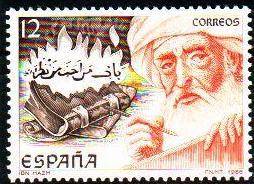
A matter of concern since the 11th century, at least.