Nice work if you can get it: Bogumil Dawison in the German theater
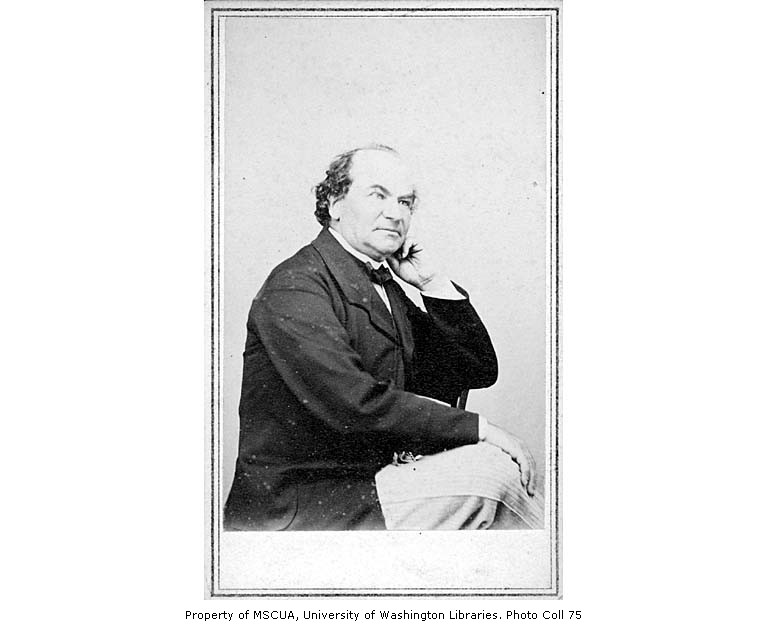
The idea that Jewish theatrical genius was a product of Jewish evolution was a common presumption in the late 19th century and early 20th century. In his 1869 ethnographic study of the Jewish “tribe” (Stamm), the Viennese rabbi, Adolph Jellinek, points to Dawison as a prominent representative of the Jewish cultural “genius” on the German stage.[1] To Jellinek, Jewish theatrical ability, like that of Bogumil Dawison, stemmed directly from two causes: the necessity of Jewish assimilation into cultures around the world, and the supposed internal, Jewish cultural trait of gesticulation.[2] Jellinek further notes that Jewish actors on the German stage are particularly suited for the “hero” roles, since they are given to a culturally inborn pathos that informs their “Oriental sagacity” and sense of the tragic.[3]
Jellinek’s theory of the Jews and their theatrical genius, which was derived from the particular talents of the Galician-Jewish Dawison, was reflected in the critical reception Dawison himself received for his performances. One British critic commenting on Dawison’s performance of Shylock in Shakespeare’s Merchant of Venice had the following to say in a glowing review of the actor’s career in 1880:
Bogumil Dawison, himself the scion of a distinguished Jewish family, represented Shylock as a religious martyr. […] He made it only too clear, to crowded houses without number, that Shylock, in suffering a terrible penalty for an unfulfilled criminal project, the motive for which, however, grew out of the persecutions inflicted upon him by his Christian tormentors, was most unjustly punished. His Shylock […] was conspicuously Jewish, in gait, demeanor, accent and gesticulation. It was […] extraordinarily powerful in the pathetic and tragical episodes, all but overstepping the frontier of the comic in the irate scenes with Antonio and Tubal. [4]
According to this account, the Jewish actor is unique because he can be both a martyr and bring comedy with his physicality.
From whence does this unique Jewish physicality derive? Precisely this question was under investigation in 1928 by Arnold Zweig, who claimed the European Jew has the ability to be a good theater actor, not because he inherits a theatrical mode of understanding a text, but because in his character traits, he brings some of the Mediterranean climate he left:
Aber wie jene ist auch er ein Freund des Lachens und der Späße; in seinen Witzen und in der genussvollen Hingabe an sie und ihr Gelächter liegt außer allem anderen noch das Klima der Komödie, des Mimus, der Saturnalien und all der Buffonieren, die uns im Norden sehnsüchtig nach soviel Leichtigkeit und Lebenselan machen.[5]
The Jewish actor, according to Zweig, is furthermore “von Grund auf Redner,” and he thinks with his ears. The Jew’s affect betrays this affinity for speaking, and “[e]r hört Sätze, indem er denkt und wenn er schreibt; sein Schreiben ist oft inneres Reden.“[6] Presumably Zweig wanted to make the connection between Jewish learning of Torah and the recitation and incantation of trope. The relationship between the gesticulations of the Jewish body, learning in Hebrew and audible voice could not be any more intimate than in Zweig’s interpretation of the Jew and his theatricality. The most important aspect of Jewish communication is not language, but gesture. Zweig states that the Jew’s body carries gestures like “Buchstaben des Alphabets am eigenen Leibe.” As he writes:
So wird ihm der Körper zum Sprechorgan […] und in der Gestikulation erst, oft erheiternd anzusehen, vollendet sich die Wortseite seines Wesens.[7]
The Jew continues to resist assimilation when it comes to the holding of his body. Zweig asserts that this is because of his strong sense of self (“…weil er sein Ich so selbstverständlich fest hat”). At the same time, the Jewish actor, according to Zweig, is able to ‘look inside’ and be open to self-criticism, making him gifted for the modern stage. In his critique, Zweig takes negative Jewish stereotypes of peculiarity in expression and resistance to assimilation and turns them around into a positive attribution of Jewish theatricality. This echoes Friedrich Nietzsche, who, in Die fröhliche Wissenschaft, similarly argues that the Jewish skill of playing (Spiel) is the transformed Jewish capacity for self-adaptation and the adoption of a new environment. Having reached its initial purpose (survival in a state of Diaspora), adaptation has transformed itself into an art form specific to the Jews.[8] As Nietzsche writes:
Was aber die Juden betrifft, jenes Volk der Anpassungskunst par excellence, so möchte man in ihnen, diesem Gedankengange nach, von vornherein gleichsam eine welthistorische Veranstaltung zur Züchtung von Schauspielern sehn, eine eigentliche Schauspieler-Brutstätte; und in der That ist die Frage reichlich an der Zeit: welcher gute Schauspieler ist heute nicht – Jude?[9]
The so-called “art of assimilation,” a process Jews were forced to learn in a majority culture like Germany if they desired to succeed in professions outside of the Jewish world, is precisely what kept Jews from being regarded as true actors. Assimilation was understood to be an mimetic ability, and this alone does not translate into virtuosity as an actor. Theater, according to the tenets of German Bildung, was the showplace for an individual’s self-realization. Actors, according to Lessing in his treatise on the theater, Hamburgische Dramaturgie, must have emotive feeling (Empfindung), which is at the depth of their (physical) being. The distinction of a true actor in Lessing’s conception is based in the physical body, and acting has an unavoidable biological component. Of the actor’s physical characteristics, Lessing notes: “Nun ist es möglich, daß gewisse Dinge in dem Baue des Körpers diese Merkmale entweder gar nicht verstatten, oder doch schwächen und zweideutig machen.”[10] Lessing acknowledges that there are persons on the stage who do not possess these distinct physical qualities necessary to be a true actor, but he denies that what they produce in the form of acting can be considered an art (Theaterkunst), rather, these “actors” merely mimetically reproduce true acting, and do not inspire their audiences. This is a crucial distinction for Lessing, one with implications outside of the purely aesthetic realm of the theater, since, for him, “das Theater [soll] die Schule der moralischen Welt sein.”[11] Lessing explains the production of the actors who do not fulfill their role as inspirers of morality, explaining that while they might possess certain apparent gifts, their internal Empfindsamkeit remains lacking:
Gegenteils kann ein anderer so glücklich gebauet sein; er kann so entscheidende Züge besitzen; alle seine Muskeln können ihm so leicht, so geschwind zu Gebote stehen; er kann so feine, so vielfältige Abänderungen der Stimme in seiner Gewalt haben; kurz, er kann mit allen zur Pantomime erforderlichen Gaben in einem so hohen Grade beglückt sein, daß er uns in denjenigen Rollen, die er nicht ursprünglich, sondern nach irgendeinem guten Vorbilde spielet, von der innigsten Empfindung beseelet scheinen wird, da doch alles, was er sagt und tut, nichts als mechanische Nachäffung ist.[12]
And so the Jew in theater was always stuck: assimilate to survive, but your assimilation will be your “moral downfall” in the eyes of Bildung.
[1] Adolph Jellinek, Studien und Skizzen, Erster Theil. Der jüdische Stamm. Ethnographische Studie (Wien: Herzfeld und Bauer, 1869), 66.
[2] “Warum sollte ein Stamm, dessen religiöse, literarische und sprachliche Entwickelung hundertfache Beweise liefert, daß er wie kaum ein zweiter in der Völkergeschichte, das Geistesleben verschiedener Länder und Nationen mit einer gewissen Virtuosität sich assimilirt, nicht Persönlichkeiten hervorbringen, welche in fremde Rollen sich so hineindenken, daß sie dieselben in’s kleinste Detail ausarbeiten und zur vollendeten Erscheinung bringen?” Jellinek, Der jüdische Stamm, 65.
[3] “Auch ist es nicht zufällig, daß die Schauspieler und Schauspielerinnen jüdischen Stammes gerade als Helden und Heldinnen im tragischen Fache excelliren. Das Pathos, welches ihm eingeboren ist und im gewöhnlichen Leben allerdings Erscheinungen hervorruft, welche ein orientalisches Gepräge an sich tragen, leistet in der Darstellung tragischer Rollen die trefflichste Dienste, wenn es von dem besänftigenden Hauche der Kunst gemildert wird.” Jellinek, Der jüdische Stamm, 66.
[4] W. Beatty-Kingston, “Shylock in Germany,” The Theatre (January & February 1880), as quoted in WWW: http://shakespearean.org.uk/shy1-bea.htm. Emphasis added.
[5] Arnold Zweig, Juden auf der deutschen Bühne (Berlin: Welt-Verlag, 1928), 24-25.
[6] Zweig, 22.
[7] Zweig, 23.
[8] Friedrich Nietzsche, “Vom Probleme des Schauspielers,” Die fröhliche Wissenschaft, Werke, Vol. 2. (Munich: Carl Hanser Verlag, 1969), 234-5.
[9] Friedrich Nietzsche, Die fröhliche Wissenschaft. Projekt Gutenberg-DE. WWW: http://gutenberg.spiegel.de/nietzsch/wissensc/wissen06.htm
[10] Gotthold Ephraim Lessing, “Drittes Stück, den 8. Mai, 1767,” Hamburgische Dramaturgie, Erster Band. Projekt Gutenberg-DE (http://gutenberg.spiegel.de/lessing/hamburg/hamb003.htm).
[11] Lessing, “Zweites Stück, den 5. Mai, 1767,” Hamburgische Dramaturgie, Erster Band. Projekt Gutenberg-DE (http://gutenberg.spiegel.de/lessing/hamburg/hamb002.htm).
[12] Lessing, “Drittes Stück.” Emphasis added.