On the Force of Daniel Josefsohn: A Triptych
What is this here? A picture of the Wailing Wall, from the men’s section because in this holy space, the men and women are divided according to the strictures of Orthodox Jewish law. The men standing there are engrossed in prayer, as most usually are at this location. Apparently they don’t notice the person in their midst with the Stormtrooper helmet on. According to Jewish law, a head covering is really all that is required for a man to enter this area of pilgrimage for Jews, so why not wear the Stormtrooper helmet?
While the men are in prayer, the Stormtrooper is alert, looking at the camera. Who is his audience? He is known to be a master marksman but here he has no weapon. Sometimes, just the image of a Stormtrooper helmet is enough to create a shiver of terror in our pop culture. In a nod to his military education, he casually wears an army green jacket. One imagines his inner life and, for the first time, the inner lives of Stormtroopers altogether. Is he a member of the tribe? Are they all members of the tribe? And that maybe that Jedi Temple had more meaning than I knew.
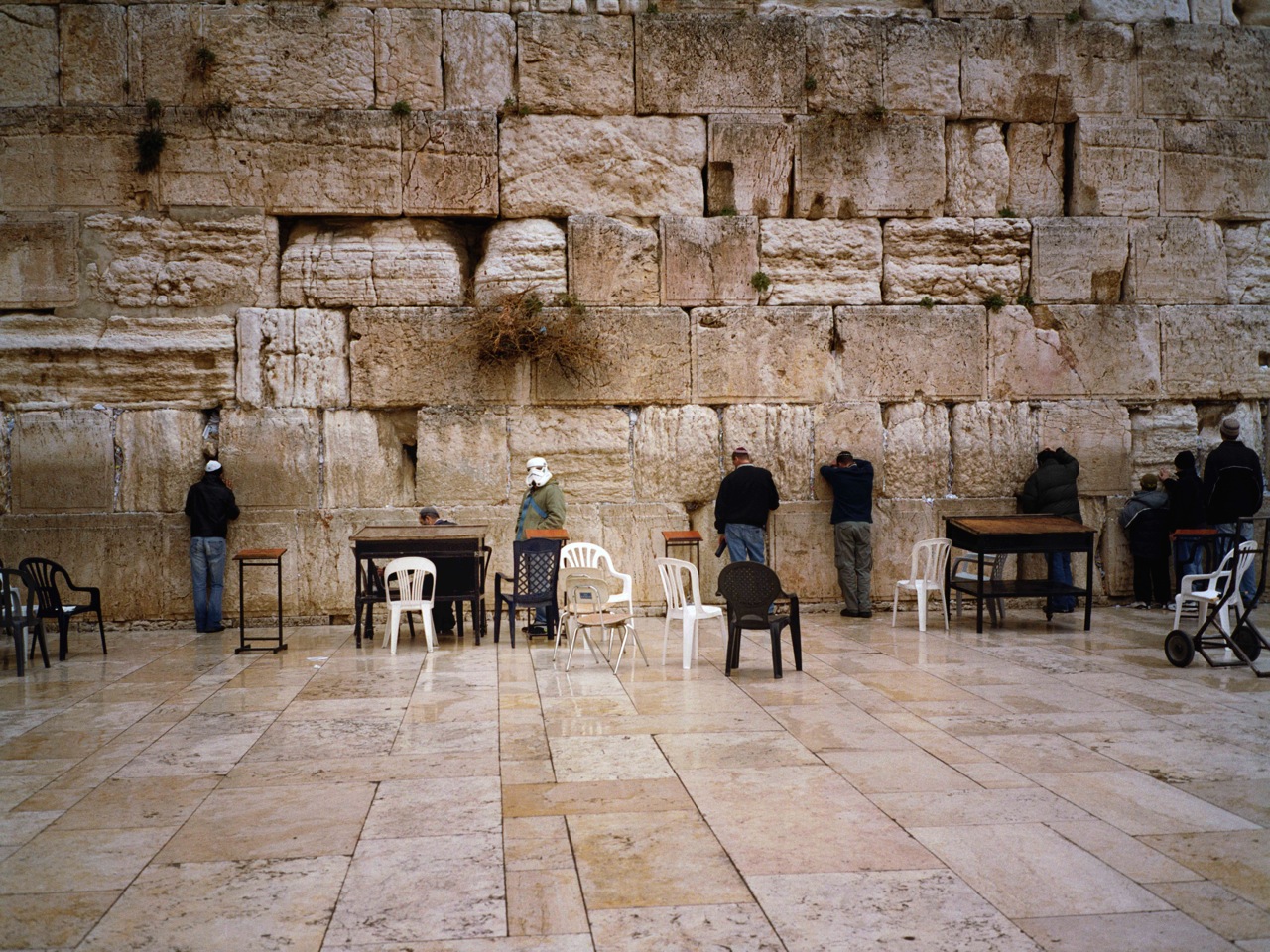
As Stormtroopers do, this one’s very presence threatens to blow the entire scene apart. As if we don’t already feel enough tension here in Israel, with religions piled on top of one another, in a powder keg of geographical location, where we paradoxically feel we were always meant to be. The Stormtrooper can blast all that shit away in an instant. Why are we staring at people praying anyway? The Wall is a very touristy, very public place that makes it hard for the average human to connect to one’s deepest wishes and entreaties to G-d. Still, it’s a terribly attractive place. Probably we want to be standing right there from that point where the Stormtrooper returns our gaze. The Stormtrooper catches us in our voyeuristic reverie.
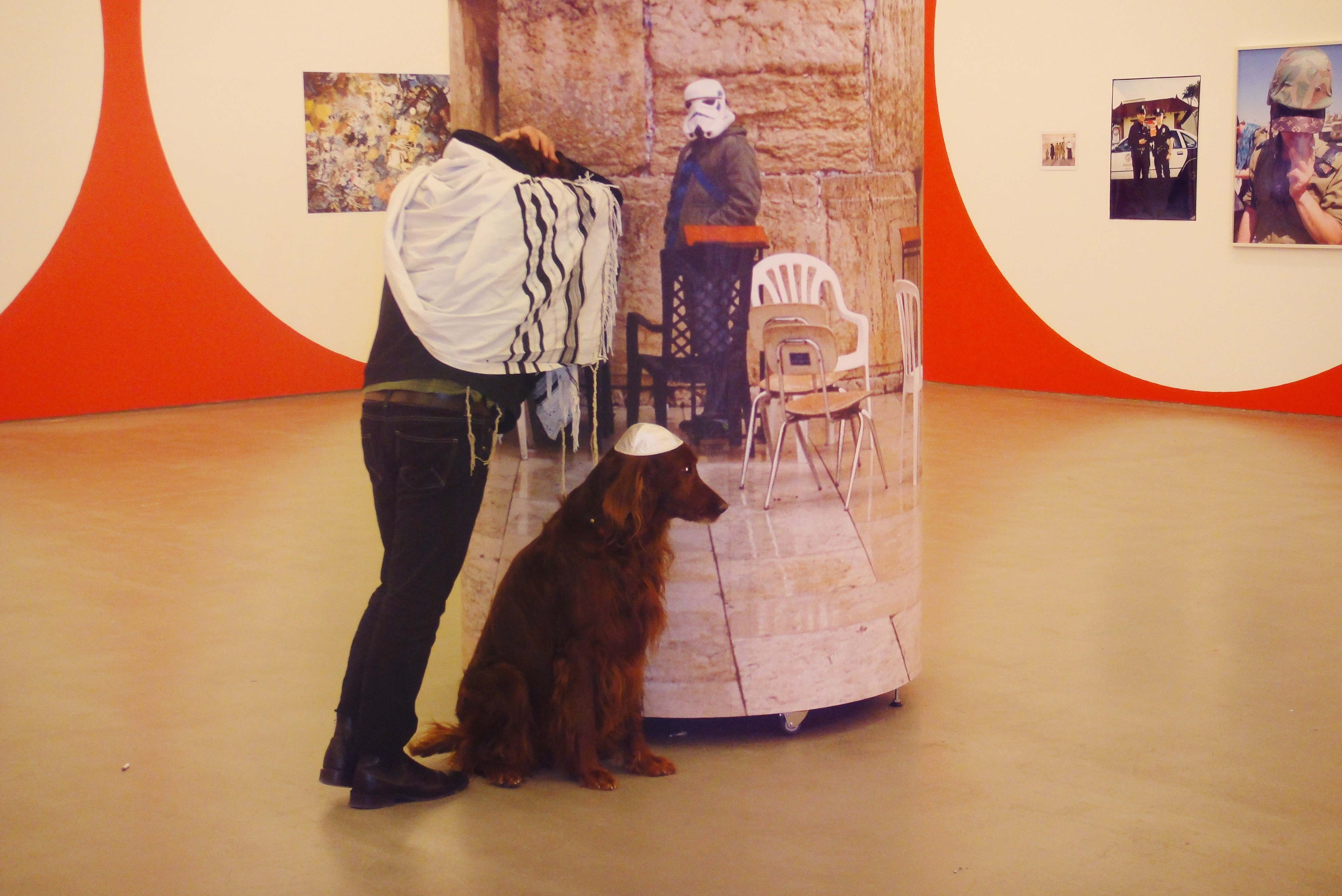
The original photograph is now papering the walls in one photo, wrapped around a pillar in another. The pillar sits in the middle of an exhibition room of Josefsohn’s work. There, Josefsohn himself is covered with a tallit, apparently now also engrossed in prayer. One imagines an intimate space he created there under the canopy of the prayer shawl, in the midst of what is probably a gallery where one usually engages in another form of reverence: that of viewing art. And, as we all know since Walter Benjamin announced it thus, art no longer has that “aura” connecting it to religious feeling in our age of mechanical reproduction. Pardon, I mean our age of digital reproduction.
Creating an intimate space under a cloth is a theme that appears often in Judaism: underneath the prayer shawl, we get caught up in our chanting, we cut out the world. Under another sort of shawl, the chuppa, the wedding canopy made of cloth, we connect with our bashert, the one we are destined to be with. How do we know we are destined to be together? Because, in effect, we are cut from the same cloth (bashert) where our destiny is written out for us. Some Jewish men pray with a shawl that was once used as their wedding canopy. That’s why I mention it.
Here, Josefsohn prays against a photographic image of the Kotel. Is the reproduction of the Wall holy enough to pray to? Where does the holiness of that place begin and end? This is the question being asked so much now during the debates surrounding the Women of the Wall, who are fighting to be able to gain access to the Wall to pray with shawls like men. So far, their claim has been denied. Most recently, they have been relegated to a side area of the Wall to pray as they wish. Should one say “relegated”? Are there more holy places and less holy places on the Wall?
And next to Josefsohn is his dog, Jesus, with a white kipah. Described elsewhere as a member of the Orthodogs, Jesus is also not allowed in the original holy space. For some Jews, Jews and dogs shouldn’t be mixing. Hell, the Middle East and dogs don’t mix, and for reasons that are not Torah-based. And, the photograph asks: for what reason, then? In the gallery, the prayer is intimate and the Wall is inclusive. And yes, I know the dog is named Jesus.
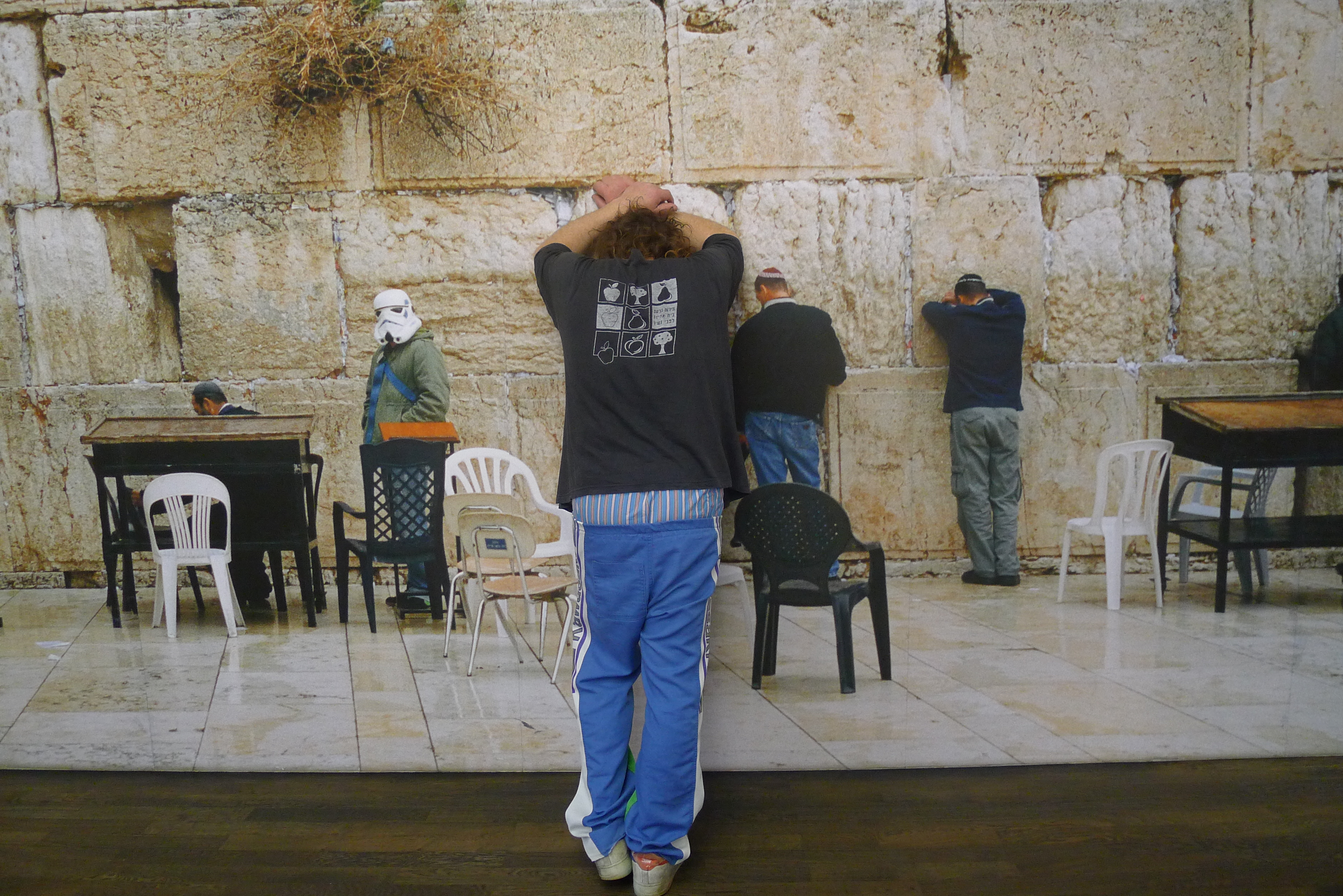
In the other photograph of the photograph of the Wall, Josefsohn stands, hip hop, pants-on-the-ground-style. People like me who read too much into things notice that his tracksuit pants and peekaboo boxers are in blue and white Israeli stripes. Allegiance. You might just think it was a tired manual laborer with a headache. It’s not even clear that this is a man praying. Until you notice that there’s someone in the photograph “actually praying” with the same pose. Wait a moment, is that man not praying, too? It’s impossible to know the true, intimate thoughts of the praying person. The image of a person conceals as much as it reveals, to paraphrase Martin H. You wonder if the praying man knows, or maybe he doesn’t know, that the pray pose is inadvertently sexy in a slouchy, overworked artist sort of way. The tension between reverence/ irreverence is everywhere here in these three photographs.
Will it make me want to look closer, stare longer, dig deeper into the interstices of the Wall to find those secrets, the intimate spaces? Or will I want to blast it to pieces? Yes on both counts. And somehow this combination seems natural to me.
This is Josefsohn’s magic.