Ping-Pong
A few days ago, David described our email-conversation as “blind tennis with net and balls but without seeing how they fly.” This post is not about tennis but about ping-pong.
In 2007, I worked at Art Basel. Gianni Motti was invited to give a talk about his work but shortly before starting, he decided not to talk but to play ping-pong with former Art Basel Director Sam Keller. We had to organize a ping-pong table in very little time, which wasn’t so easy. But finally, we got a table and they played ping-pong for the audience.
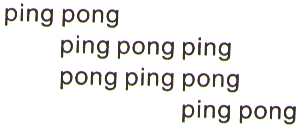
Due to its metaphorical potential, ping-pong has always been a popular subject matter for artists. Concrete poetry (Eugen Gomringer, to be precise) investigated the term.
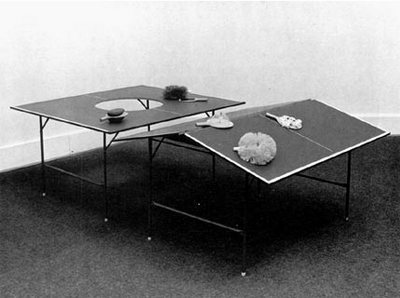
In the 1970s, George Maciunas used ping-pong tables and rackets for his installations and performances.
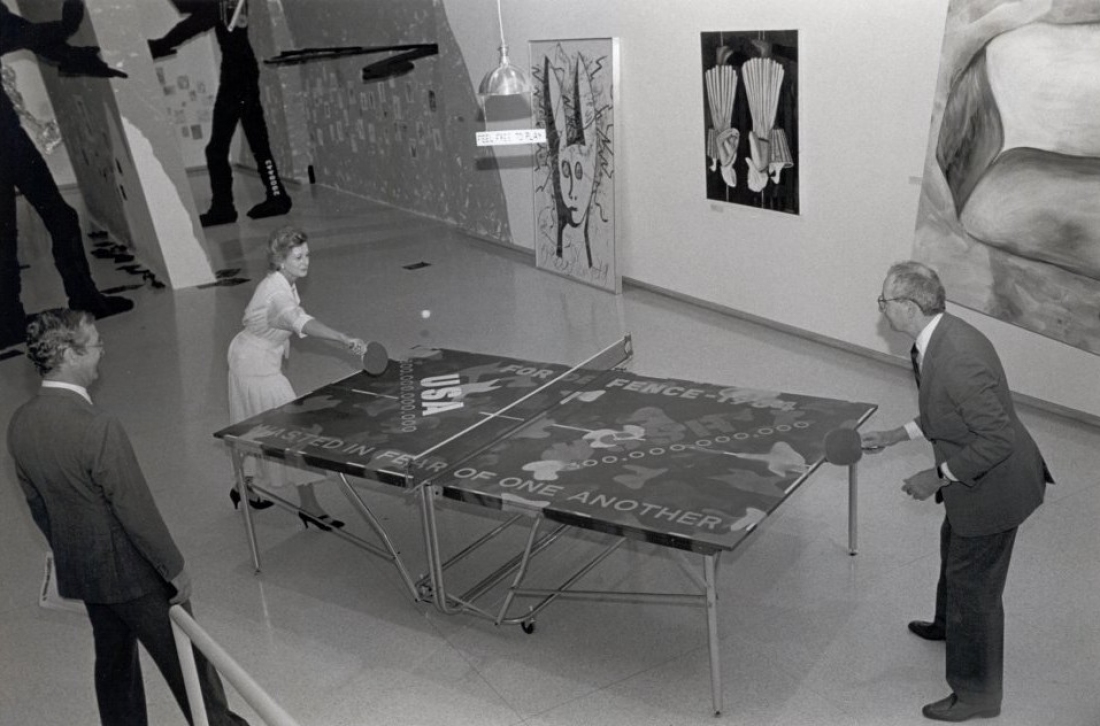
In the 1980s, Jonathan Borofsky included ping-pong in his exhibitions.
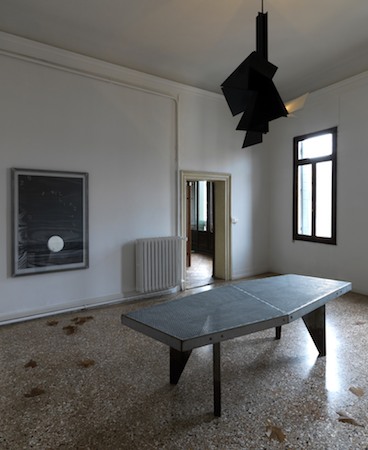
And today, the list would be far too long, if it would contain all the artistic positions working with ping-pong or ping-pong tables. (Martin Boyce is only one example.)
But ping-pong is not only popular in contemporary art but also in politics. (At least in the 1970s).
“Ping-pong diplomacy” was called the 1970s Cold War relations between the United States and the People’s Republic of China. “The term described the sending of a team of US table tennis players to China in 1971 to play in a tournament that was promoted under the banner ‘Friendship First, Competition Second’ that acted as a forerunner to President Richard Nixon’s visit to Mao’s PRC in 1972.”
There is one figure, who is the real ping-pong hero (at least for Nokia): Bruce Lee.
http://www.youtube.com/watch?v=OqGQ72bre30