Placebook (01)
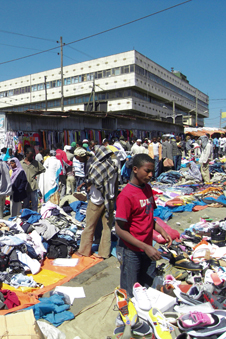
Addis Ababa, Ethiopia.
Living outside of Europe makes me realize that in most places of this rapidly urbanizing world the cities are younger than the people who live in them. In Europe, cities are always older than their inhabitants, history is being accumulated in built heritage, and cities works as a collective memory. But it is hard to see this happening in the fast growing cities of Africa or Arabia, where half the population is under age and has not witnessed more than a decade or two of its history, and where old neighbourhoods are destroyed within days, and vast new urban expansions are built up within a few months.
Addis Ababa is such a city. I spent quite some time there, sometimes for weeks, for months, and finally for two years. With every stay I could witness the city changing with breathtaking speed and scale. The village-like fabric of small sheds is bulldozed to make way for big building blocks, and the border of the city is constantly shifted further into the hinterland. The only consistent elements within this rapidly and violently changing city seem to be the buildings that were built during the 1960s.
These buildings are special, indeed. Half a century ago, Addis Ababa became the capital of Africa. By being the only African country that was never colonized or founded by colonizers Ethiopia naturally played a leading role in the African independence movement of the post-war area. And, consequently, its capital city was chosen as the permanent seat of the African Union headquarters. A building boom started, and for one decade Addis Ababa became a playing field for architects from all around the world.
In the 1960s a new generation of modernist architects emancipated from the rather narrow and homogenous canon of formal features set by the first modernists in the 1920s, and in many countries separate discourses on architecture developed. It is from these divergent sources that the modern architecture of the 1960s in Addis Ababa was informed. Architects from various countries and cultural backgrounds like France, United Kingdom, Germany, Sweden, Israel, Russia, Austria, Greece, Finland, Bulgaria, Italy, Yugoslavia, the United States, and last, but not least, also the first architects from Ethiopia, all contributed with individual designs to the modern architecture in Addis Ababa. Their works were inspired by the new isms of the 1960s: brutalism, structuralism, critical regionalism, futurism, minimalism, expressionism, modern classicism, pragmatism, tropical modernism, monumentalism. Not in many places can such a variety of influences be found.
Addis Ababa is certainly rather unexpected place for such a rare collection of modern architecture at one particular spot. Of course, not all buildings are masterpieces, but in total they represent the varied discourses on modern architecture of the 1960s. Today, these buildings can be sources of inspiration in the current building boom in Addis Ababa where the strong images of modernization often overpower the more modest attitudes of modernity.
These special buildings are part of the still very young history of the city. Whether they are heritage is, however, not up to a foreigner to decide.
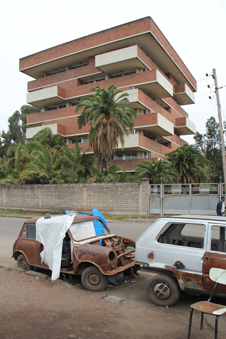
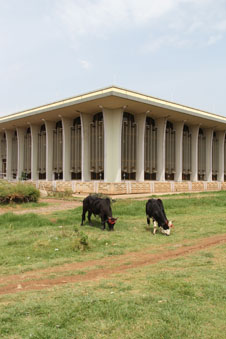
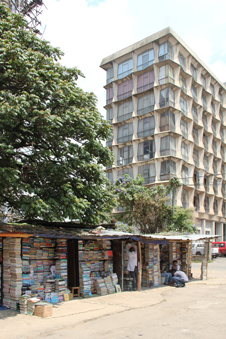

Addis Ababa, Ethiopia.
Living outside of Europe makes me realize that in most places of this rapidly urbanizing world the cities are younger than the people who live in them. In Europe, cities are always older than their inhabitants, history is being accumulated in built heritage, and cities works as a collective memory. But it is hard to see this happening in the fast growing cities of Africa or Arabia, where half the population is under age and has not witnessed more than a decade or two of its history, and where old neighbourhoods are destroyed within days, and vast new urban expansions are built up within a few months.
Addis Ababa is such a city. I spent quite some time there, sometimes for weeks, for months, and finally for two years. With every stay I could witness the city changing with breathtaking speed and scale. The village-like fabric of small sheds is bulldozed to make way for big building blocks, and the border of the city is constantly shifted further into the hinterland. The only consistent elements within this rapidly and violently changing city seem to be the buildings that were built during the 1960s.
These buildings are special, indeed. Half a century ago, Addis Ababa became the capital of Africa. By being the only African country that was never colonized or founded by colonizers Ethiopia naturally played a leading role in the African independence movement of the post-war area. And, consequently, its capital city was chosen as the permanent seat of the African Union headquarters. A building boom started, and for one decade Addis Ababa became a playing field for architects from all around the world.
In the 1960s a new generation of modernist architects emancipated from the rather narrow and homogenous canon of formal features set by the first modernists in the 1920s, and in many countries separate discourses on architecture developed. It is from these divergent sources that the modern architecture of the 1960s in Addis Ababa was informed. Architects from various countries and cultural backgrounds like France, United Kingdom, Germany, Sweden, Israel, Russia, Austria, Greece, Finland, Bulgaria, Italy, Yugoslavia, the United States, and last, but not least, also the first architects from Ethiopia, all contributed with individual designs to the modern architecture in Addis Ababa. Their works were inspired by the new isms of the 1960s: brutalism, structuralism, critical regionalism, futurism, minimalism, expressionism, modern classicism, pragmatism, tropical modernism, monumentalism. Not in many places can such a variety of influences be found.
Addis Ababa is certainly rather unexpected place for such a rare collection of modern architecture at one particular spot. Of course, not all buildings are masterpieces, but in total they represent the varied discourses on modern architecture of the 1960s. Today, these buildings can be sources of inspiration in the current building boom in Addis Ababa where the strong images of modernization often overpower the more modest attitudes of modernity.
These special buildings are part of the still very young history of the city. Whether they are heritage is, however, not up to a foreigner to decide.