Placebook (02)
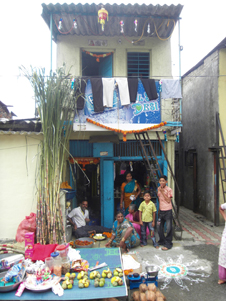
Pune, India.
Every so often another “house of the future” comes on stage. In papers and presentations. At biennales and triennales. Made with lots of words, garnished with images of shiny, happy people, surrounded by the latest gadgets. The echoes of these projects, however, don’t last for very long, and they certainly never reach out to where housing really matters, to where the future of our cities is decided: to the slums, shacks and shelters around the world.
For the millions, or even billions of people that are hoping for a future despite their poor circumstances of living in the ever growing cities, for those who want to take the very first step up the housing ladder out of the slums, there is one kind of building that occurs as a model solution everywhere around the world. When housing development is not hindered by slumlords, not hindered by governors, not hindered by ideologies of forced or forbidden homeownership, when people are left to do what they deem best, no matter in which culture, climate or city, they eventually build some kind of a shophouse.
For example, in Pune, one of the fastest growing cities in the world, I once walked through a “zopadpatti” or so-called slum area. This place is rather centrally located, thus offering opportunities for survival to the inhabitants that no peripheral location would do. Just a step off the large main road, a narrow alley leads into this neighbourhood that shows qualities, which are desperately sought after in any top-down driven urban housing project.
Without romanticizing other people’s poverty, this place strikes me as balanced. A narrow, lively road filled with people, but not congested, slow traffic, mainly pedestrian, some two-wheelers. Narrow, and deep plots. Land titles might or might not exist. But in any case, people have built what they feel is appropriate. Two- to three-storey houses, with shops on ground floor, direct access via a ladder or stairs to the residences on top. Activities are spilling out onto the street, a street for people, a “street with eyes”. Shivajinagar feels safe, proud, and homely.
Here, housing is not a noun. Not a countable unit in any housing programme. Here, housing is a verb. It is the life in and around the houses. The houses are merely a means to an end: survival on a level of decency. This is rarely found around the world. If only these shophouses would be known as the houses of the future.

Pune, India.
Every so often another “house of the future” comes on stage. In papers and presentations. At biennales and triennales. Made with lots of words, garnished with images of shiny, happy people, surrounded by the latest gadgets. The echoes of these projects, however, don’t last for very long, and they certainly never reach out to where housing really matters, to where the future of our cities is decided: to the slums, shacks and shelters around the world.
For the millions, or even billions of people that are hoping for a future despite their poor circumstances of living in the ever growing cities, for those who want to take the very first step up the housing ladder out of the slums, there is one kind of building that occurs as a model solution everywhere around the world. When housing development is not hindered by slumlords, not hindered by governors, not hindered by ideologies of forced or forbidden homeownership, when people are left to do what they deem best, no matter in which culture, climate or city, they eventually build some kind of a shophouse.
For example, in Pune, one of the fastest growing cities in the world, I once walked through a “zopadpatti” or so-called slum area. This place is rather centrally located, thus offering opportunities for survival to the inhabitants that no peripheral location would do. Just a step off the large main road, a narrow alley leads into this neighbourhood that shows qualities, which are desperately sought after in any top-down driven urban housing project.
Without romanticizing other people’s poverty, this place strikes me as balanced. A narrow, lively road filled with people, but not congested, slow traffic, mainly pedestrian, some two-wheelers. Narrow, and deep plots. Land titles might or might not exist. But in any case, people have built what they feel is appropriate. Two- to three-storey houses, with shops on ground floor, direct access via a ladder or stairs to the residences on top. Activities are spilling out onto the street, a street for people, a “street with eyes”. Shivajinagar feels safe, proud, and homely.
Here, housing is not a noun. Not a countable unit in any housing programme. Here, housing is a verb. It is the life in and around the houses. The houses are merely a means to an end: survival on a level of decency. This is rarely found around the world. If only these shophouses would be known as the houses of the future.