Placebook (04)
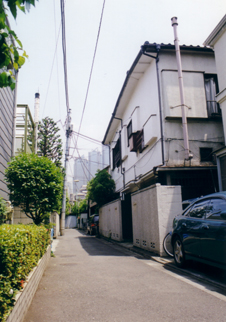
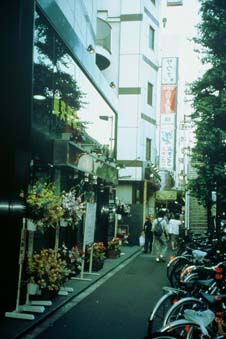
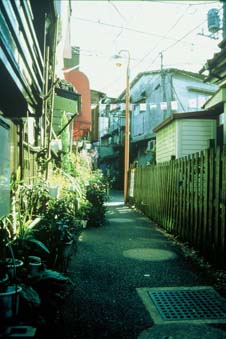
Hatsudai, Japan. In Japan, all dimensions are extreme: what is big is huge and what is small is tiny. Tokyo, the world’s biggest city, is based on a very small-scale urban fabric. Most the 27 million people live in houses, which are smaller than 100m². Except for the areas around the train stations, the image of the city is composed like a pointillist picture of millions of small dots. My neighbourhood in Hatsudai, Tokyo, for example, consisted of densely packed, detached houses. Hardly ever higher than two storeys. Small gaps of perhaps half a meter between them. Narrow streets, which are not wider than only a few steps. Potted plants everywhere. In such city quarters, and there are many of this kind, the global city that Tokyo is resembles a village.
This village-like urbanity is so comfortable in scale and atmosphere that private activities, which in other cultures and places all happen within the boundaries of a home are externalized into the city. Since the houses are so limited in space the whole neighbourhood eventually becomes part of the house. The ubiquitous convenience stores make up for a kitchen, the many food stalls substitute the dining room, the many small public baths replace the bathrooms, instead of in a living rooms one can entertain friends in a private room of the karaoke bar, and finally the love hotels can be used as externalized bedrooms. All that remains for the house to be is to serve as a neutral retreat. A room that is devoid of any other function than shelter. The house is like a tent pitched up in the urban field. In such kind of urbanity the house is merely a space without programme.
Japanese architecture has come a long way from the rather authoritarian visions of the 1960s metabolists, which thought of ideal cities consisting of small cells of living units clustered around centrally organized stems of circulation and services. Today, one finds independent, individual and varied interpretations of small-scale architecture plugged into a large network of urban functions. The metaphor of the city as a metabolism still holds true, but no longer organized in a top-down manner, but rather bottom-up.
Within in this changed view of the city, the approach to architecture also transformed. Whereas the generation of architects like Tadao Ando designed small houses as opposed to the urban world that was conceived as hostile, the recent designs of young Japanese architects like Sou Fujimoto are radically exposed to the city and perceive their urban environment as a living space. The opening of the minihouses towards the city and the living outside of the house are an expression of a lifestyle that superimposes without contradiction today’s hypermodernity of functions and services with Tokyo’s traditional small-scale urbanity.
photos (c) Michael Jahn
Hatsudai, Japan. In Japan, all dimensions are extreme: what is big is huge and what is small is tiny. Tokyo, the world’s biggest city, is based on a very small-scale urban fabric. Most the 27 million people live in houses, which are smaller than 100m². Except for the areas around the train stations, the image of the city is composed like a pointillist picture of millions of small dots. My neighbourhood in Hatsudai, Tokyo, for example, consisted of densely packed, detached houses. Hardly ever higher than two storeys. Small gaps of perhaps half a meter between them. Narrow streets, which are not wider than only a few steps. Potted plants everywhere. In such city quarters, and there are many of this kind, the global city that Tokyo is resembles a village.
This village-like urbanity is so comfortable in scale and atmosphere that private activities, which in other cultures and places all happen within the boundaries of a home are externalized into the city. Since the houses are so limited in space the whole neighbourhood eventually becomes part of the house. The ubiquitous convenience stores make up for a kitchen, the many food stalls substitute the dining room, the many small public baths replace the bathrooms, instead of in a living rooms one can entertain friends in a private room of the karaoke bar, and finally the love hotels can be used as externalized bedrooms. All that remains for the house to be is to serve as a neutral retreat. A room that is devoid of any other function than shelter. The house is like a tent pitched up in the urban field. In such kind of urbanity the house is merely a space without programme.
Japanese architecture has come a long way from the rather authoritarian visions of the 1960s metabolists, which thought of ideal cities consisting of small cells of living units clustered around centrally organized stems of circulation and services. Today, one finds independent, individual and varied interpretations of small-scale architecture plugged into a large network of urban functions. The metaphor of the city as a metabolism still holds true, but no longer organized in a top-down manner, but rather bottom-up.
Within in this changed view of the city, the approach to architecture also transformed. Whereas the generation of architects like Tadao Ando designed small houses as opposed to the urban world that was conceived as hostile, the recent designs of young Japanese architects like Sou Fujimoto are radically exposed to the city and perceive their urban environment as a living space. The opening of the minihouses towards the city and the living outside of the house are an expression of a lifestyle that superimposes without contradiction today’s hypermodernity of functions and services with Tokyo’s traditional small-scale urbanity.
photos (c) Michael Jahn