Pushing 60 (4)
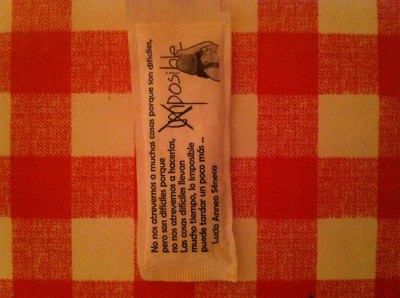
Today I am tapping on in the spirit of come-what-may writing. This morning’s sugar packet wisdom was Seneca, the younger, giving some good advice about the importance of daring to give time to things that seem difficult or impossible. Transforming the impossible. It’s unsurprising that motivational speech has been a feature of communication since ancient times.
I think of depression and disappointment and how many tweets give regular encouragement to the desperate, always variations on a theme,
‘fail to prepare, prepare to fail’.
Yuck.
Too symmetrical and reeking of Baden-Powell.
I much prefer one that came to me out of the blue,
One day I just said to myself
‘RECALIBRATE HOPE’
I didn’t get it from any known source and think it most helpful.
I’ve tried it on a few disappointed adults along with the reminder to choose the cheese sandwich option as Camus did on any given day when the choice, between suicide or sandwich, hovered.
I mentioned ‘recalibrating hope’ to a friend before Christmas and he called me ‘Clarence’.
He said he was desperate and then I appeared and shared all the wisdom from sugar packets and beyond and he began to recalibrate hope in front of my eyes.
It’s important to forget about the lost causes but easier said than done sometimes…
When it’s tough I remember
WC Fields who said ‘if at first you don’t succeed try try, try again and then give up, don’t be a damn fool about it’.
If you can’t forget then go on in and remember till it’s not so compelling. I think forcing forgetfulness is dangerous (at any age) but being open to the pleasure of forgetting is vital in pursuit of recalibration.
On the subject of memory, I always quote my acid tongued Aunt.
At the time my mother was being evicted from her home of 60 years, the house in Chelsea she didn’t own, my aunt was particularly tart.
I will forgo telling the long and grim story, of greed in our time, to get to the punch line to which I am heading.
I often advise that ‘I am dedicated to a punch line’ when I notice listeners drifting off or trying to change the subject.
If I am heading somewhere particular, however many detours, I always return to my path. This might be because I am a Capricorn like Jesus and David Bowie who incidentally lived in Chelsea in the same street as I did. He led a very different sort of life from mine, I presume, but always smiled at me on my way home from school. I was never able to smile back although I practised.
In the early seventies it was impossible to be nonchalant with David Bowie.
His first girlfriend, Dana, had been to my school so he probably liked the uniform. I knew a lot about him. He painted his house black I heard.
I don’t know if it was true but I liked the thought that his black paintwork would be white underneath whereas our white walls were black underneath.
Our house had been a boys’ crammer, a house of misery one presumes where little boys had to study, in what were once known as the inter-war years, in black rooms.
Back to the punch line.
My aunt, impatient with my mother’s vacant stare and weepy eye in 2003, asked me what I thought the matter was. My aunt was 90 at the time. I answered that it was a terrifying prospect to be uprooted in such a callous way at such a time and mumbled something about the ghosts.
My aunt, in an even more impatient voice, asked
‘Does she believe in ghosts?’
‘Well’ I said and paused ‘memories…’
‘Oh’ said my aunt in exasperation ‘the best thing to do with memories, Marcia, is (pause) forget them’. I wonder about this often as I try to remember to forget.
I look at my mother, now reading about Pompeii, and think of her staring out to sea happy in her thoughts. I must ask her how she trains her mind to play the happy scenes over and over. I won’t disturb her now but I would like to know.
Today I received photographs from our friend in Cartagena who helped translate Scorza yesterday. His mother had escaped into France in 1936 with her little cousins whose parents, school teachers, had been brutally murdered by Franco’s army. One of the cousins has written a book and we discussed it.
He said ‘you would like it, it’s very personal and full of stories’ .
Apparently his mother didn’t want to remember or tell her story. She is my mother’s age and also wants to think happy thoughts.
I remember liking his mother so much back in the seventies. She was very beautiful and very tough. We used to walk in the Retiro gardens and sometimes meet her friend who was the daughter of Charlie Chaplin. Her friend, Geraldine, asked me if I’d like to be in her husband’s film about punks. As ever ambivalent, I said ‘no thank you’.