Quix
Nostalgia is a nice feeling, I grant you that. It still is a little odd to me how readily people feel it these days, especially about media. It might have something to do with how fast things are outdated, now but I’ll spare you my amateur take on media theory. Instead, I present to you the Quix, a little known device that existed between 1995 and 2000.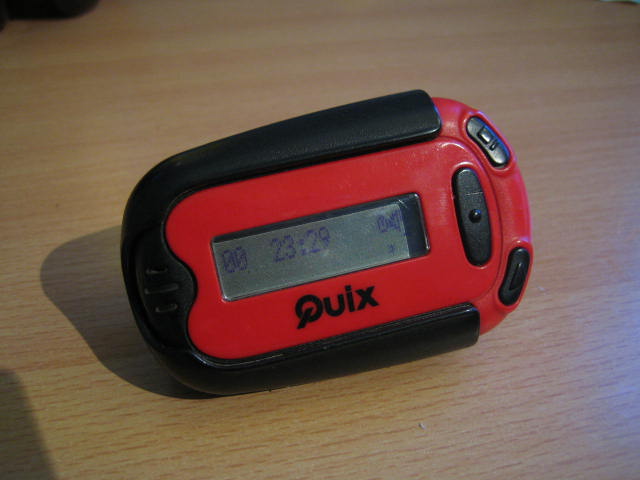
It was essentially a pager that could deliver short messages. All you had to do was call a hotline and share whatever you wanted to say with an operator, who then typed it into a computer and sent it to the Quix. Basically, it was a slightly moronic way of text messaging. Yes, I owned one of these. It’s embarrassing to partake in the miscalculations of a company, but then again, I was young and easily impressed by new gadgets. When it comes to the MiniDisc- player, I don’t think I was the only one who misjudged the situation – most of my friends owned one of those and now we get to reminisce together about our naiveté. It’s interesting to see the cultural divide in this kind of nostalgia. My American friends can talk for hours about MSN messenger (which shut down this year) and LiveJournal (which, inexplicably, still exists), whereas Germany was always a little slow on the uptake; most of these devices went out of fashion before they even reached this country. But of course, we had our own failed social media sites: Lokalisten, which was used mostly in Bavaria, StudiVZ and last, but not least, jetzt.de, which still exists but mostly abandoned its social networking aspirations.
In 1995, Bruce Sterling started the “Dead Media Project”, a website with the intention of collecting all media that doesn’t exist anymore. In his manifesto, he writes: “Plenty of wild wired promises are already being made for all the infant media. What we need is a somber, thoughtful, thorough, hype-free, even lugubrious book that honors the dead and resuscitates the spiritual ancestors of today’s mediated frenzy. A book to give its readership a deeper, paleontological perspective right in the dizzy midst of the digital revolution. We need a book about the failures of media, the collapses of media, the supercessions of media, the strangulations of media, a book detailing all the freakish and hideous media mistakes that we should know enough now not to repeat, a book about media that have died on the barbed wire of technological advance, media that didn’t make it, martyred media, dead media.“ He imagined the project as eventually being published, as a coffee-table book on acid-free paper (paper!). I don’t think it ever was and even the website seems to be out of commission, but you can look at the collection of dead media here. Sterling’s musings are still as relevant as 8 years ago and I can’t help but hope that there is a “cutting-edge early-21st century publisher” out there who has the stamina to continue this project.