Remember November
“Schieß doch, Jude!” That’s what Daniel Josefsohn always says. Of course he means with a camera. His camera. You see, he’s a photographer in Mitte and he’s gotta survive, after all, amidst all that Mitteschmerz because Germany is giving birth to its new identity there.
And so in that context, when you make statements of any kind, you have to go big or go home. And this three-word statement is a big fat hand grenade of words. Explosive. But deeply funny.
At least I think Josefsohn means to shoot with his camera. His camera is actually a wonderful weapon. (More on that later.) Jews have had a number of weapons at their disposal to cope with life in Europe, but most of them aren’t obviously dangerous. Fabian tells me that cooking is one of them, based on his observations of his own mother. And I tend to agree, since most Fridays I am paralyzed after Shabbat dinner by an innocent-seeming, sweet Nudelauflauf called kugel. Pow! Pow! Schieß doch!
These words ricochet around in my head once again when I think of the case of Hershel Grünspan (Grynszpan), whose assassination of the German Nazi diplomat Ernst vom Rath in Paris on November 7, 1938, became the Nazis’ official excuse for why they unleashed the German state-sponsored Kristallnacht two days later, on November 9.
(We should be careful not to agree with this sequence of events, even if they did occur in the manner that history describes. The truth is, Grünspan shot the Nazi diplomat because the Nazis were persecuting Jews, not that the Nazis persecuted the Jews on Kristallnacht because Grünspan shot the diplomat. The order here is irrelevant.)
Here’s one of the few pictures of Grünspan, upon his arrest by the police after shooting vom Rath. He looks like a character in a noir film, don’t you think?
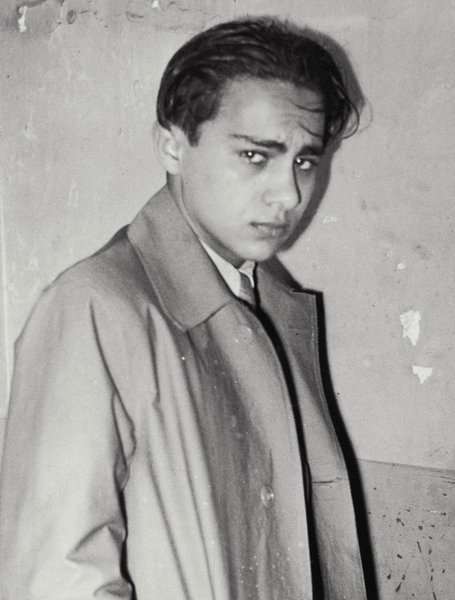
The story, according to sources and a new book this year by Jonathan Kirsch is that Grünspan killed vom Rath in retribution for the deportation a few days prior of seventeen thousand German Jews, including Grünspan’s own family members, who were forcibly sent from their home in Hannover to a camp in a town in Poland called Zbąszyń. The Germans call this town Bentschen, which is hard for me to write because in Yiddish this word means “to pray” or “to say a blessing.” For example, “likht bentshen,” which means to light candles on Shabbat. That’s what I did on the 9th of November because, you see, this year it fell on Shabbat.
Anyway, there’s a lot of mystery surrounding Grünspan’s life before and his life after shooting vom Rath dead. This much is known: the Gestapo made him a high priority arrest when they made it into France. He was imprisoned and locked up in concentration camps and was even supposed to be the subject of a show trial by the Nazis until he threatened to claim a homosexual relationship with vom Rath as the reason for his murder. It was a terribly clever threat, and it was most likely an untrue story, but it did manage to infuriate Goebbels enough that no show trial ever took place.
What happened to Grünspan in the end? No one seems to know for certain, but he probably died in 1945, despite some post-war sightings. A Stolperstein was placed for him in Hannover a few years ago. Miraculously, his deported family survived the concentration camps.
I had no idea about Grünspan until yesterday when I was reading some German press about commemorating the 75th anniversary of the Night of Shattered Glass this weekend. How he has never become an object of interest like the events of the Warsaw uprising, I will never know. Maybe no one cares because of all of the monstrous shit that happened after his shots rang out.
I grew up mostly in the United States, where I have been in more than one terrorizing situation involving guns and shooting and violence. And I hate all of it. I hate it. But when I first heard about Grünspan, there was at least one moment where I imagined this teenager as some sort of hero who took political matters in his own hands. Someone who should have ended up in a filmic scene of revisionist history right next to the Bear Jew in Inglorious Basterds. Someone who lived in that time of fear when, it seems, only those people who were street smart knew the horror that would follow. I wondered if it was difficult for him to justify what he was about to do. And I imagined him saying to himself, like a mantra or a prayer for battle, seconds before he pulled the trigger, “Schieß doch, Jude!”
On the 9th, Germany remembered the monstrous, evil shit that followed that moment. Aber dieses Jahr hatte ich die Ereignisse des 7. November 1938 im Visier. Am 9. November habe ich mir eine Kerze gezündet und hob likht gebentsht. Es folgte aber keine Explosion. Nur der übliche Gruß – “Shabbat shalom”.