Revisions: 27
“There is no pure, non-technical apprehension of speed, nor any non-technical aspect to time.” It’s as impossible to conceive of time as a construct as it is to conceive of time without use of a construct. Lived time in a world of networked communication technology is governed by [more]
“There is no pure, non-technical apprehension of speed, nor any non-technical aspect to time.” It’s as impossible to conceive of time as a construct as it is to conceive of time without use of a construct. Lived time in a world of networked communication technology is governed by information transferred at relatively high speed.
Time = information / information = speed.
Imagine the blinking light on your wireless router: the faster it blinks, the more information is moving. That’s your clock. So our temporal reality – not just work/leisure time, but also circadian rhythms, travel, growth – is constructed according to the speed of information transfers. Time is experienced via input/output across the selective interface of consciousness. (Consciousness, not comprehension.)
There is a lot of shit for you to read in your browser tabs today. I recently installed Instapaper in Chrome so I can endlessly save things for “later” (= never); this makes me feel like I’m taking in more information than I am, and lets me move a lot faster through the tabs. Like letting steam off a boiling kettle. How does the speed of input compare to output? It’s very hard to produce content as quickly (with as little comprehension) as it is to absorb content (click the Instapaper icon). Is there a moral imperative here? Should producing take longer than consuming?
The poor prosumer. The lucky prosumer!
The prosumer of online text-based media asks: do the pros of democratic publishing outweigh the cons of the shit writing that proliferates given such speed and ease? Is there a moral imperative here? Do you have to contribute because you can? How fast are you supposed to contribute?
Over the last year a tiff has gone on in architecture publishing about quantity vs. quality of writing in the field (not so different from the debates in other publishing genres since… always). A recap via links for you to Instapaper:
1. “The Day Architects Stopped Reading Newspapers” by Jan Loerakker for Failed Architecture
2. “International Architecture English: Drunk texting and the art of the international press release by me for uncube (where I am an editor)
3. “Buzzfeed, Bikinis and the Big Rethink: The case for de-democratizing the architectural press,” by Phineas Harper for uncube
4. “ A Case for the Democratization of Architectural Media” by Rory Stott for ArchDaily
Four very different publications with different financial models, credos, and stakes in the debate. A recap via twitter for speed:
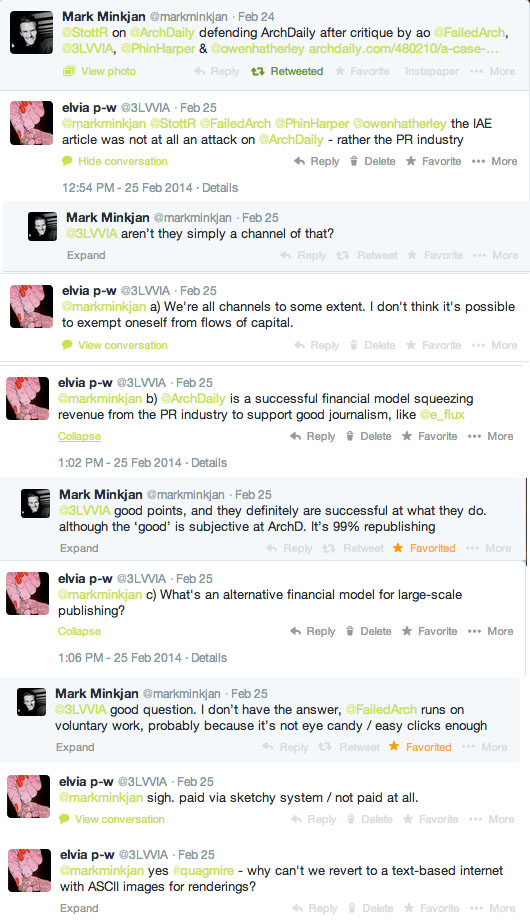
To say that fast is necessarily bad, or that things must be paid for or slowly sanctified via traditional print publishing models to ensure their quality would be wrong and make me sound regressive. Worse, it would be to say that someone (me) is an objective arbiter or judge of “quality” content – and that my measure of quality is good ol’ hard work. But wait, I’m a critic! I judge quality for my job. Speed is not my main barometer for qualitative judgment, but I like slowness because if you spent time on something you are accountable for the result. Otherwise when it receives valid criticism it you can say, “sry, I made that so fast, can’t rly stand behind all aspex.”
The steam engine was upsetting to a lot of regressive, stupid, anti-progress technophobes in the late-nineteenth century: “fast travel is changing the experience of time, ruining nature/humanity etc etc!” (even Jules Verne was sarcastic about progress in Around the World in 80 Days (1873): “Thus was celebrated the inauguration of this great railroad, a mighty instrument of progress and civilization, thrown across the desert, and destined to link together cities and town which do not yet exist. The whistle of the locomotive, more powerful than Amphion’s lyre, was about to bid them rise from American soil.” Later he points out that the train’s “wheels crushed those who fell upon the rails as if they had been worms” and had some other problems.)
The industrial revolution happened, sry, nothing was harmed, chillout, progress, and High Frequency Trading is powered by the wheels of that same locomotive. Fast is a given, don’t be technophobic, ok. When I talk about speed of information I’m just talking about accountability.
(Argument: Shit content that is carelessly published at lightning-speed converts ur skin and the mucus membrane that hugs your brain and the thin padding of spinal fluid around your vertebrae into selective interfaces that are constantly in action controlling information: “Complex, emergent systems such as body/planet/city now become cybernetically inflected inputs/outputs/controls,” as Beatriz Preciado has written in reference to architecture.)
(Argument: if architecture writing is information is speed, then architecture becomes information is speed; right now Zaha Hadid’s new building in New York is being constructed w some kind of loco-motiv algorithm transmitted in real time across time zones to another; prosumed in a single moment in different hemispheres; Zaha could be sleeping thru it, but from one look at her you can tell the woman never sleeps; she’s got her eyes wide open underwater (sea-witch) collecting human voices in jars & gorging on parametric equations.)
This post is an excuse-planation for my upcoming 60 days of posting on this website very quickly. In the end I’m not so worried about writing so much, since you won’t read it all (NOT A MORALIZING STATEMENT) but rather wondering why things one writes quickly should not remain on one’s hard drive.
60 days from today I will go “off the grid” (which grid?) to a “remote” (= no remote comunication) island in Lake Superior with no friends and no computer. That will be my experiment in “non-networked time”; I will still receive information via my sensory interfaces and time will be produced through this experience, but remote communication at high speed will not contribute to my temporal reality. So 100% output before screeching to information-halt. Maybe the content-blitz will carry the momentum necessary to keep producing “content” without a wordpress tab open?
pls respond w any suggested edits, thkyou!
*****************
(The two first sentences of this post were taken from an essay called “Network Time” that I wrote about the work of Spiros Hadjidjanos. The starting quote is from Adrian McKenzie, in his V GOOD book Wirelessness.)