Smooth Hound Sig-Nature. Sharks, Writing, and Evolutionary Computing.
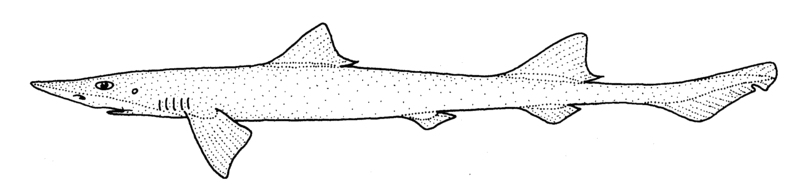
In the first days of September and on the very last day of summer, I was sitting at the English shore of Essex, watching the tide roll away and enjoying a few cups of bottle fermented Rosé sparkling wine called “Mount Bluff” with Eva, the artist David Gates, whom we were visiting there, and his London gallerist Domo Baal. David, who has been living in a remote cottage in Essex for years, is a peculiar man of fierce wit and a way of thinking and producing art that is not of this time, and yet it is. In his garden, you’ll find an old caravan, which he has remodeled to work as a giant pinhole camera. He will soon try and tow it to a luxurious British garden estate close by where he works as a gardener. We have known David for a while now, ever since his mail art started fluttering into our Berlin apartment, often cut up into many fragments by himself and then kindly reassembled and held together by tape or rubber bands, courtesy of diligent German postal workers. Eva has shown his work in our apartment in Berlin during Gallery Weekend, while I carried his artworks to Shanghai and Beijing, widening his network and documenting it. But this was the first time I met him in person. He is a very good swimmer and knows a lot about fish, crustaceans and plants. There are sharks in Essex waters, small ones, mind you, and they are called “smooth hounds”, or Gollum atenuatus.
David told me about a machine used by, among others, the President of the United States of America, which is a single purpose apparatus for reproducing the presidential signature. The first patents for a contraption like this, which emulates something distinctly individual and supposedly “natural” universally used for authentication, were issued in 1803. It was called AUTOPEN and later ROBOT PEN. It stores one signature, or can be used to remotely sign a document – not digitally, but mechanically, much like the machines used for copying keys.
I find this quite interesting in a time where not only theorists like Friedrich Kittler have observed the disappearance of writing. Handwriting is extremely difficult to recognize or forge with a computer, as if writing, the very cultural technique of inscribing language – transposing the real continuum of speech into the realm of the symbolic and intrinsically artificial – , is some new form of nature still evading the grasp of technology. Then I found a recent paper on the brilliant arXiv.org simply called Generating Sequences With Recurrent Neural Networks, which “shows how Long Short-term Memory recurrent neural networks can be used to generate complex sequences with long-range structure, simply by predicting one data point at a time. The approach is demonstrated for text (where the data are discrete) and online handwriting (where the data are real-valued). It is then extended to handwriting synthesis by allowing the network to condition its predictions on a text sequence. The resulting system is able to generate highly realistic cursive handwriting in a wide variety of styles.” The result is handwriting without hands, a post-human sig-nature:
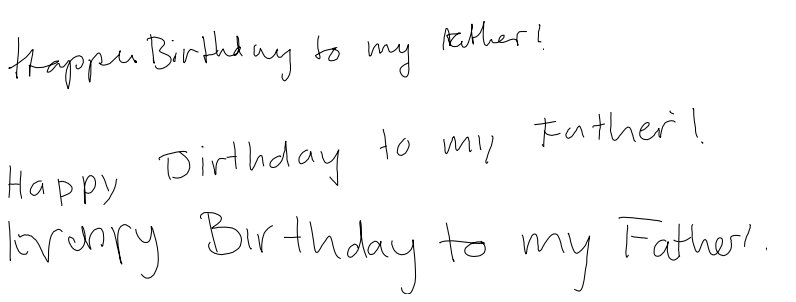
You can try it out here:
Recurrent Neural Network Handwriting Generator Demo
PS: Happy 67th Birthday to my father!