Space oddity
During our first and as yet only conversation Maxime was pouring champagne into his vodka drink at Elise’s party in a “no pain no gain” effort which clearly backfired but seems to be constitutive of this guy’s eclectic ideology. While happily ruining the drink he was telling me that reading Erwin Panofsky’s 1925 “Perspective as Symbolic Form” had changed his life. Panofsky’s text is canonical for decoding central perspective as a cultural construct and a system of symbolic interpretation of the visible rather than a “true” form of representation of nature or reality. Hearing this from a tattoo artist seemed to be a lead to something unexpected.
Maxime explained his fascination for Panofsky in an eerily stylized London accent with which—as he later mentioned—he had consciously replaced his Swiss French accent over the past two or three years. This too seemed interesting to hear from somebody who is as forensically unique and recognizable as it gets, covered head to toe in ink.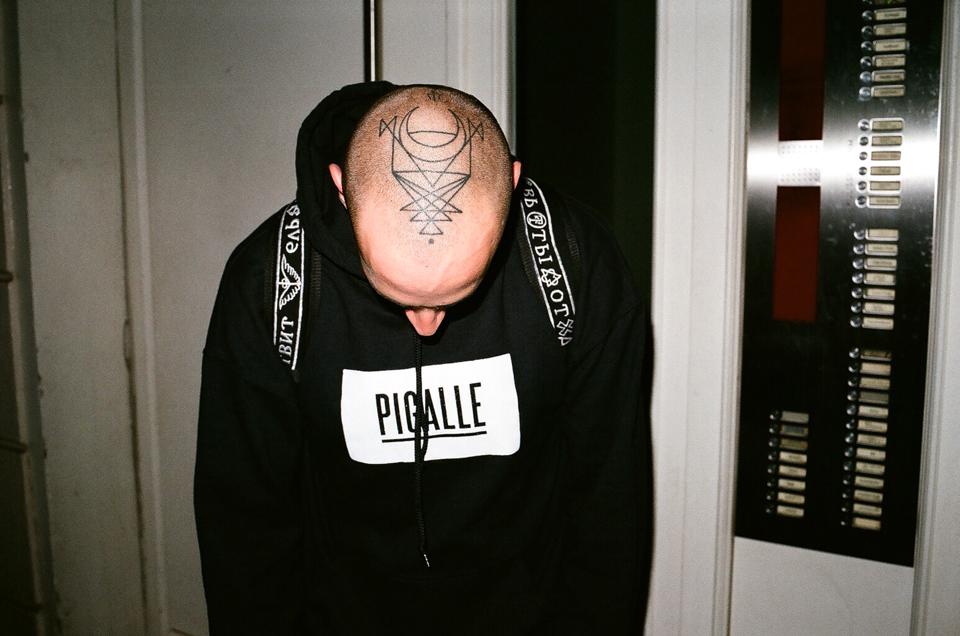 (photo by Maxime Ballesteros)
At the time (it was still summer) I was researching the discovery of non-Euclidian geometry in the 19th century. Non-Euclidian geometry (hyperbolic and elliptic geometry, Riemannian and higher-dimensional space, etc.) describes space that doesn’t fulfil all of Euclid’s axioms: rules that had been accepted as the epitome of mathematical and scientific truth for more than 2,000 years. Realising that these could not be upheld as objective truths plunged Western science into a deep crisis and paradigm shift that slowly began to conceive of mathematics as not necessarily compatible with empirical or intuitive truth, and paved the way for manifold fields of research ranging from the theory of general relativity to the concept of the algorithm to a play written by Lewis Carroll, author of Alice in Wonderland: “Euclid and his Modern Rivals”. The “Modern Rivals” in the play were represented by the character of Professor Niemand (German for “nobody”). Professor Niemand and the real Professor Riemann instigated a vault into higher dimensions and hyperspace that also found some resonance in the arts. Duchamp, Picasso, the Constructivists were all fascinated by the Fourth Dimension.
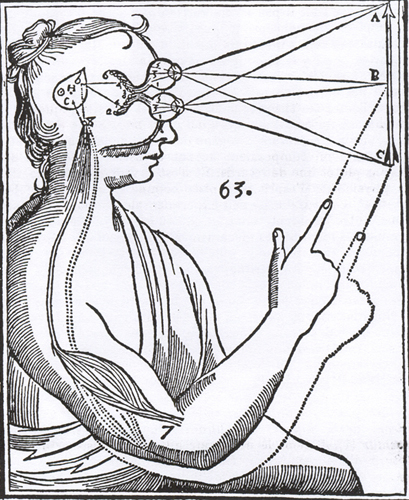
In a sense, the human body also offers a kind of non-Euclidean geometry, a space oddity of curves, orifices and palindromic folds, albeit one that superficially seems to yield itself to perspectival projections. Some of Maxime’s tattoos seem to have had a past life as medieval woodcuts, as adaptations from Dürer’s book on measurement “Underweysung der Messung, mit dem Zirckel und Richtscheyt, in Linien, Ebenen unnd ganzen corporen” of 1525, or Descartes’ diagrams of mind and body from the 17th century—when central perspective still reigned sovereign and the mind was a camera obscura absorbing the linear rays of the outside world through the singular peephole. The canvas for the tattoos however, skin, is always a warped version of the two-dimensional tableau structured by a Cartesian grid.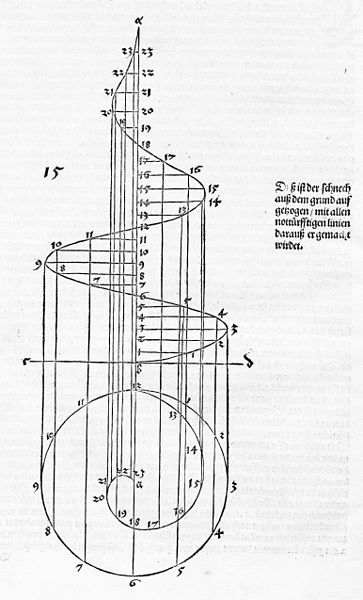
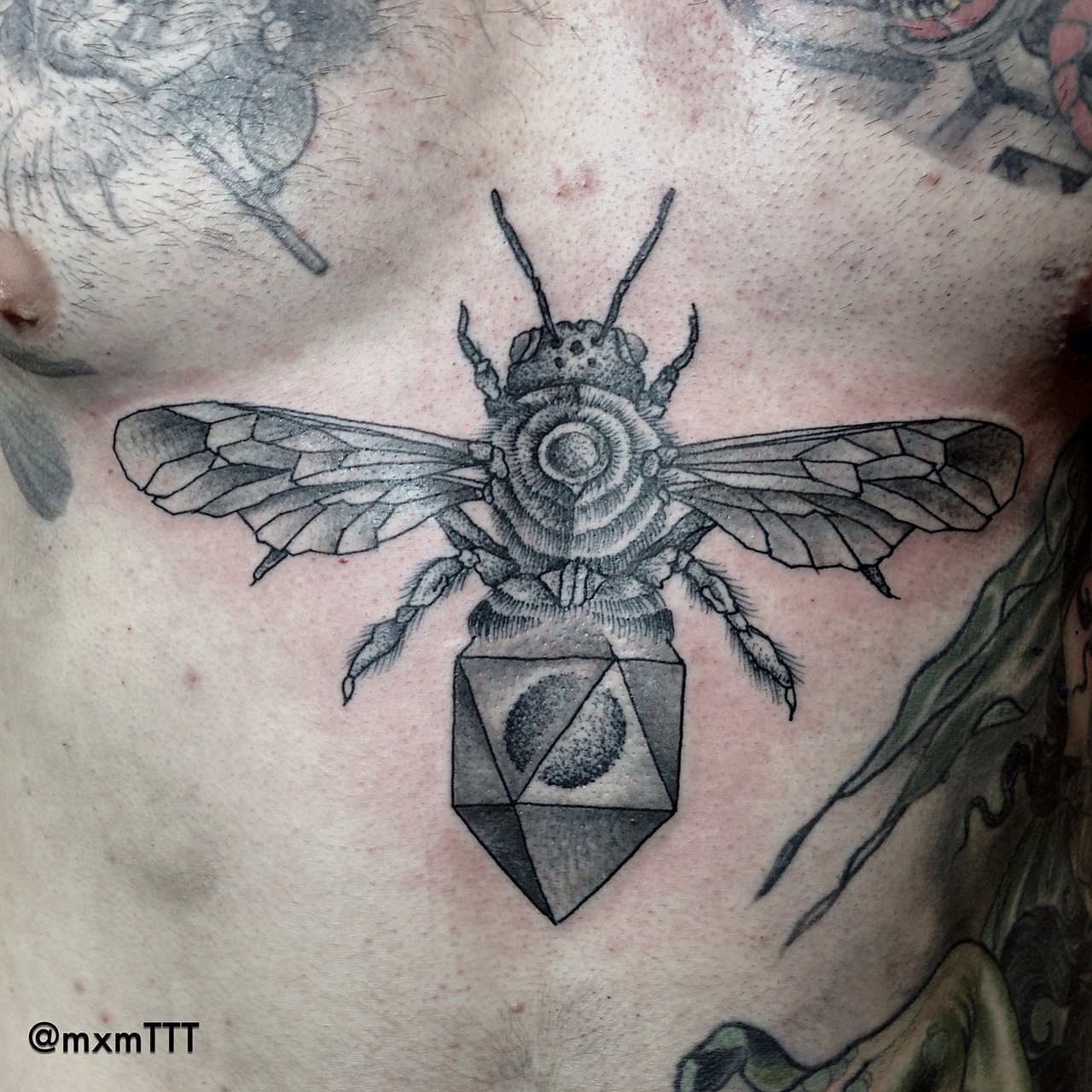
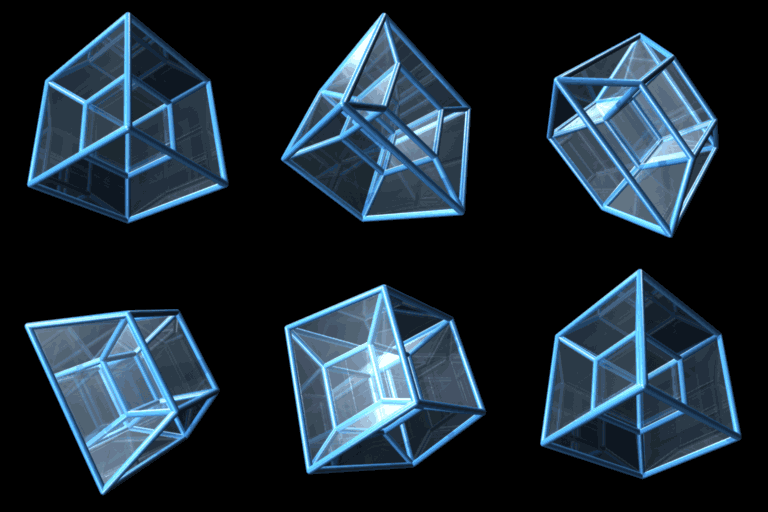
The designs by Maxime that are most interesting to me are hybrid forms of biology and geometry, bees with icosahedronic butts, platonic bodies on platonic buddies, Brunelleschi architecture on shoulder blades, Vitruvian diagrams on n-dimensional calves and hipbones. It would be nice to be able to get a four-dimensional hypercube tattoo, but I think that I will have to wait until somebody invents holographic ink.