The lunatics are on the grass
Yesterday, Christina told me a story about Buckminster Fuller: To make people aware of the movement of earth through space, of the maniacal speed of “Spaceship Earth” through the cosmicomics of our universe, he would tell them to stand with arms outstretched, probably somewhere near Lake Eden on a Black Mountain College campus lawn, ideally at sunset, and wait and listen to the body orienting itself toward the force fields of the cosmos, gravity, rotation, the Great Attractor. “Do you feel it now? Do you feel it now?”
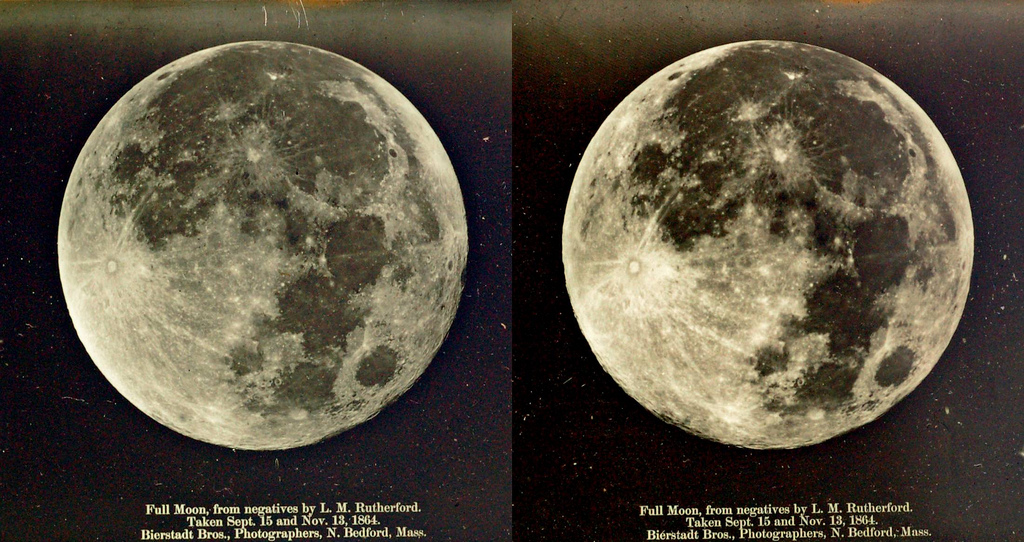
In 1864, L. M. Rutherford produced a stereoscopic image of the moon. In this case, he couldn’t move the camera a couple of centimetres to the left or the right to produce the parallax difference necessary to create a three-dimensional image. Instead, he had to wait for two months for the moon itself to move. The moon, due to the path of its orbit around the earth, oscillates in relation to us down here at the shores of Lake Eden. Lunar libration is the slow rocking back and forth of the moon as seen from the earth over the passage of its happy laps. On September 15 and November 13 1864, this lunar lap dance was choreographed into a single, stereoscopic image. Space translated into flat photography becomes space once again, but its condition is the passing of time. “Zum Raum wird hier die Zeit”, as Wagner wrote.

Coincidentally, the viewers of this lunar fugue on earth are graced also by a courtesy call from the rest of the cosmic posse: scratchy sketchy spots of stars in the photographic distance, some of whom have travelled 4.000 light years to be here for this group portrait.
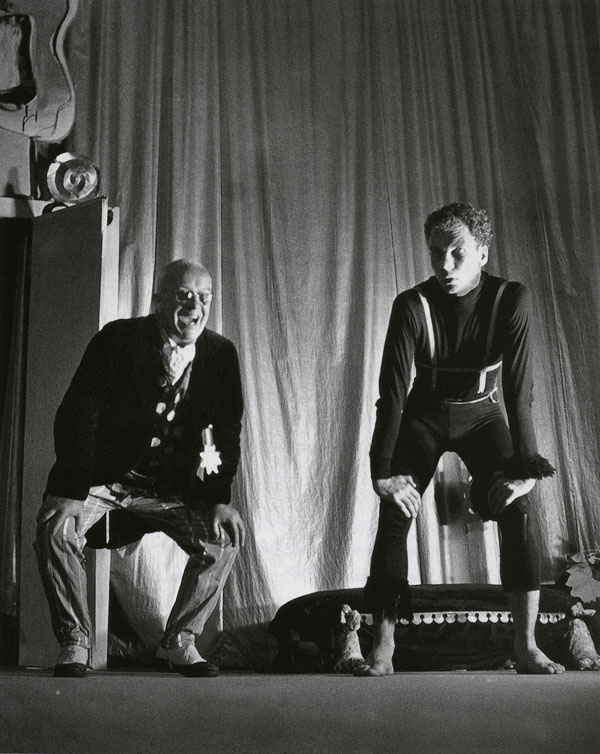 (Buckminster Fuller and Merce Cunningham performing “The Ruse of Medusa” at Black Mountain College in 1948)
If for some reason now you are wondering what happens to tears in space, watch this:
http://www.youtube.com/watch?v=q9S4ofhyOe8