The Rosenthaler Platz Converses
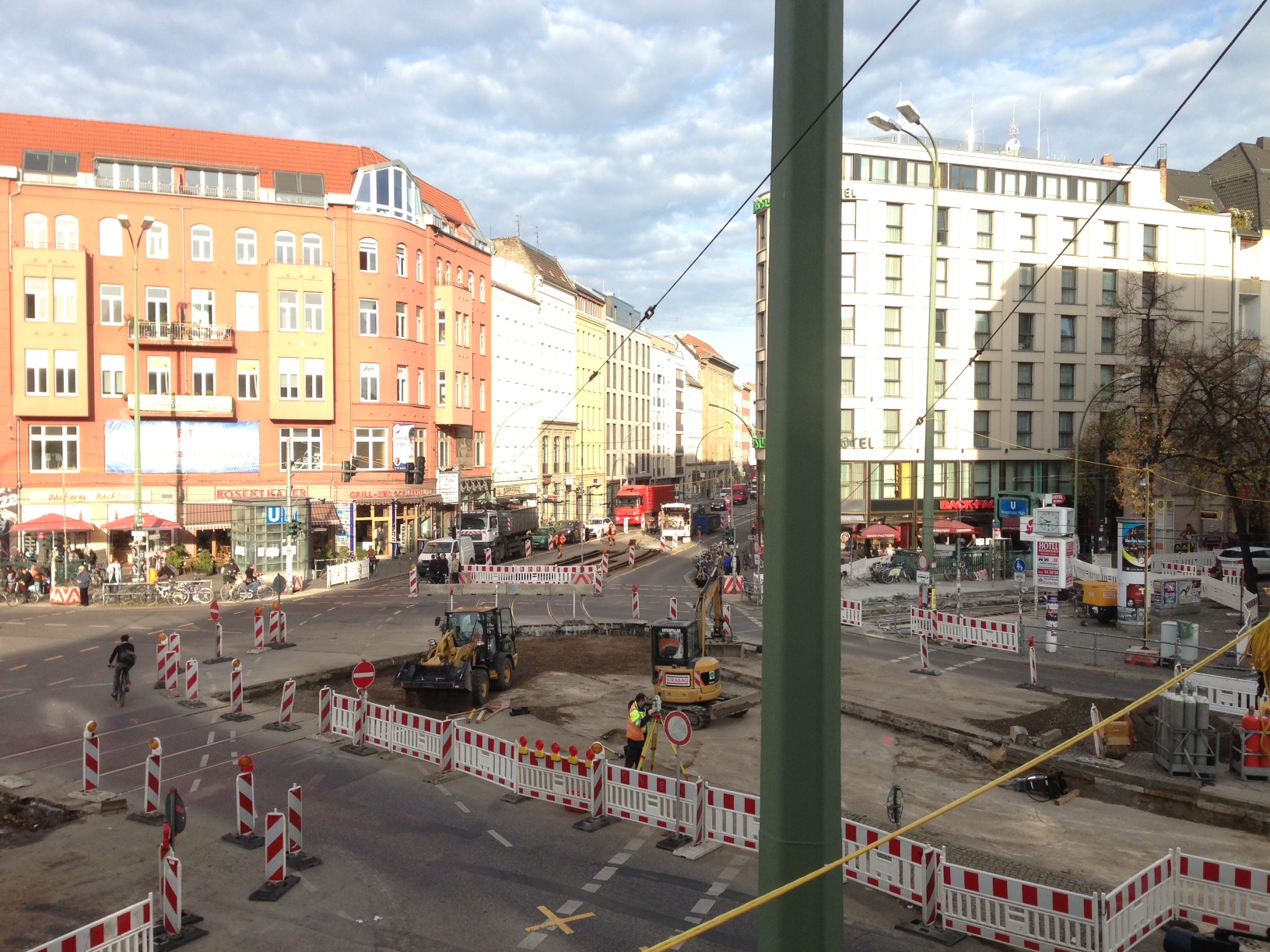 Today, our crash course on Method Acting was both a lesson and an exercise. We met at the Rosenthaler Platz where a lecturer in German literature from the Humboldt-University gave us some background to the famous novel Berlin Alexanderplatz, by Alfred Döblin. Of course, the Alexanderplatz gave the book its title, but the actual story is located around the Rosenthaler Platz. Döblin wrote this novel in the late 1920s after a rather naturalistic period. This naturalism is still alive in some parts of the book (if I remember the lesson properly). Specifically the technique of montage, first described by Walter Benjamin in his essay on Döblin’s novel, might be interpreted as a phenomenological way to handle daily aspects and phenomena in a scientific manner. There is a famous chapter in the novel: The Rosenthaler Platz has a conversation (orig.: Der Rosenthaler Platz unterhält sich), which is simply a collage of newspaper headlines and a description of the scenery in an almost unemotional way. The square, the people and the scenery are producing the text, automatically. Constantin Stanislawski, the father of Method Acting, was highly influenced by this passage. For him, it wasn’t the post-naturalistic moment that was decisive, but the idea that something could become something different. Houses, places, tramways could become actors. In this sense, Döblin became the grandfather of Method Acting. We followed this path of surprising continuity by spending almost two hours staring out of the window: watching the conversation of the Rosenthaler Platz.