The walk (Miguel taught me)
I once was participating in an ecological project on the West coast of Mexico. We were saving turtle eggs, mainly from the hawksbill sea turtle (“Karettschildkröte” in German, which sounds much more interesting), as turtle eggs are a delicacy in Mexico (and supposedly good for your virility). Very rarely there was a leatherback sea turtle, but usually you only could spot the “Autobahn” it made into the sand, as it had been slaughtered by a “huevero” (egg thief) long before we arrived.
We lived a Robinson Crusoe like kind of life. We had a beach hat. There were mosquitos, there were snakes, there was flooding. We were working the nights when the turtles came. Hawksbill sea turtles lay between 80-150 eggs into a hole they dig into the sand. You can easily take them out from behind as the turtles are in a kind of trance while giving birth. Next to us was a shelter for guys who had drunk their brains out of their head, literally. They were nice, running like crazy at the beach in big groups, grinning with an eternal smile. Except them, nobody was there.
Working for us was Miguel, a Mexican. He was, unlike us, paid for his work (not much incentive otherwise). He was the kind of guy who could build a castle in the jungle with his machete. He already had grandchildren but you couldn’t guess his age (between 40-100). He was taking too much crystal meth (the stuff from “Breaking bad”). He put four spoons of sugar into his coffee. He was never without his machete, and he always called me Davis.
I didn’t like him. Still, I went many nights out with him. The beach had two sections. 7 km to the left. 7 km to the right. We did 15-20 km every night. Collecting around 5-10 plastic bags full of turtle eggs. Miguel was always barefoot, yelling at me with his black teeth that I was just a slow gringo, knowing nothing. I didn’t care much (and my Spanish was not very good, either). However, Miguel had one point. He knew how to walk fast. And he told me how to do it (the way I still walk), pushing your shoulders in front of you all the time (some people might call it a “poser” walking style, I don’t care).
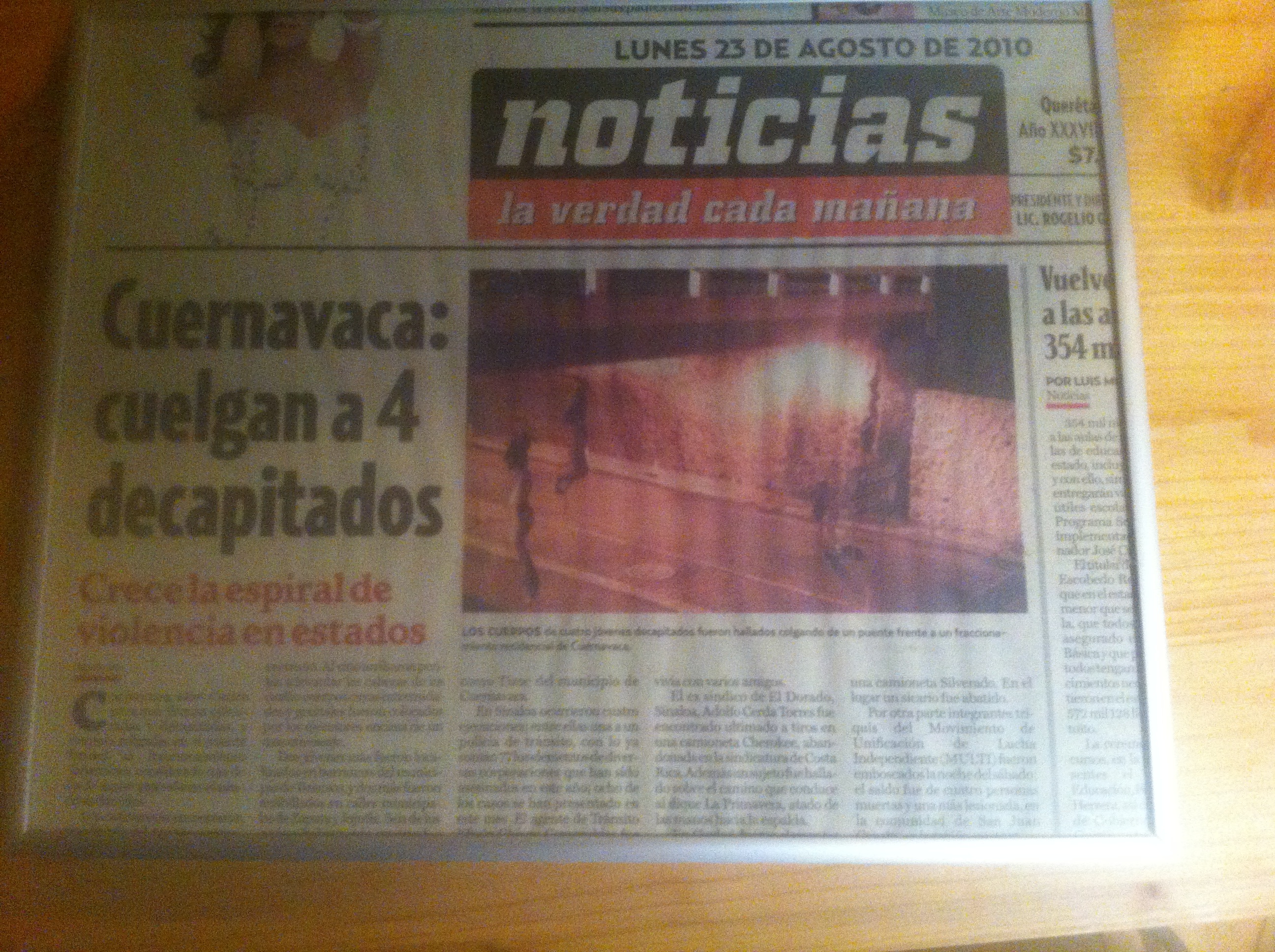
Last time I was in Mexico I didn’t go to the West coast. I was at a wedding in Querétaro. I was reading Roberto Bolaño’s 2666 and every day Mexico felt a little scarier. Half of it was coming from the book, the other half from newspaper stories like this (I still have the picture):
I don’t know how Miguel is doing. Probably he is dead. But when I walk as I walk I think of him sometimes. And I think of Mexico, hoping it is doing well in a way.